Mouse and Rat Poison: Why It Often Makes the Problem Worse
Poison works: the mouse eventually dies. The problem is where — and what happens next. The delay is built in by design, and it is exactly what sends the animal off to die inside the wall.
In brief
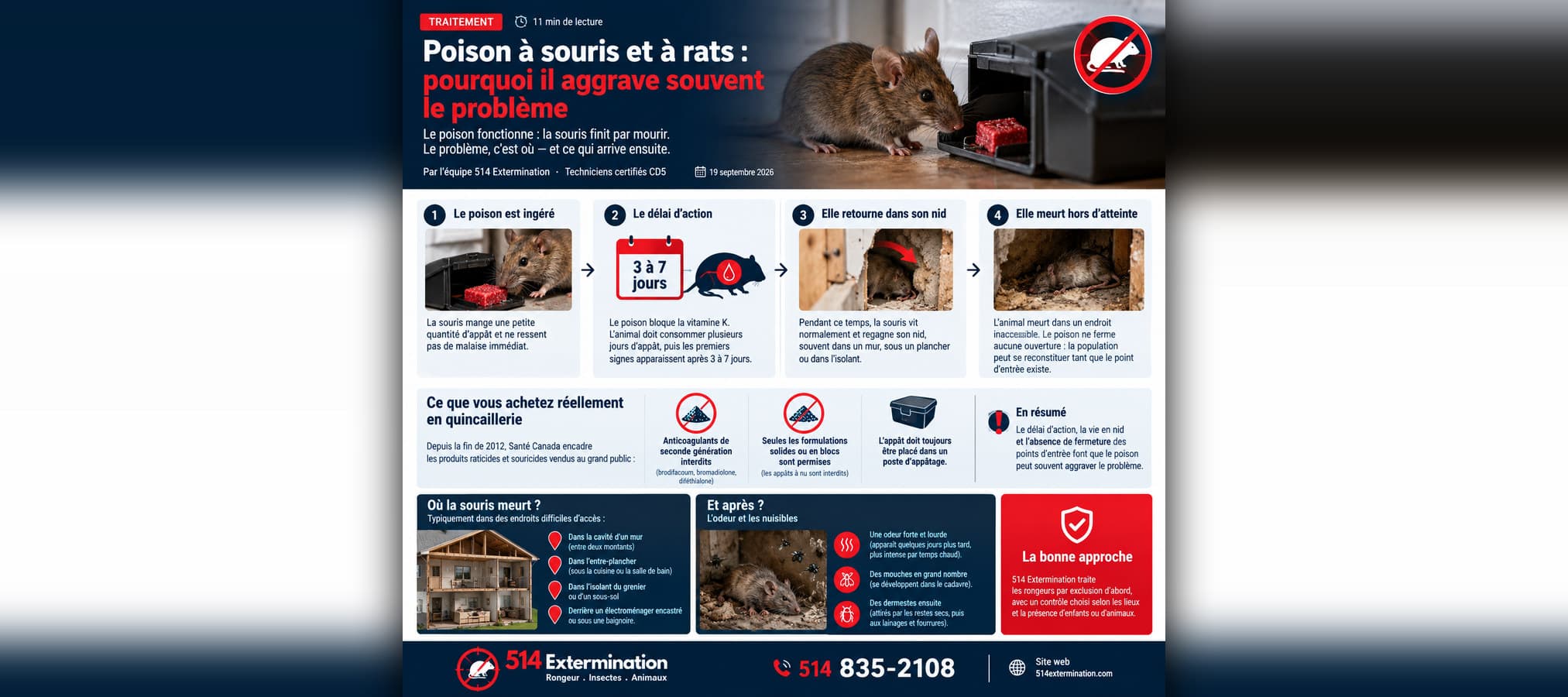
In Canada, rat and mouse poisons sold to the public have been regulated by Health Canada since the end of 2012: second-generation anticoagulants (brodifacoum, bromadiolone, difethialone) are banned from them, only solid or block formulations are allowed, and the bait must always sit in a bait station. What remains on sale works slowly, by design: these anticoagulants often have to be eaten over several days, and signs only appear several days after that. The delay stops the mouse from linking the bait to feeling sick — but it also gives it time to return to its nest, which is most often inside a wall, under a floor or in insulation. That is where it dies, out of reach. Poison also closes no openings: as long as the entry point exists, the population rebuilds. 514 Extermination treats rodents with exclusion first, with control methods chosen according to the premises and whether children or pets are present.
What you are actually buying at the hardware store
Many people think they are buying the same product professionals use, in a smaller size. That has not been true for more than ten years.
Following its re-evaluation of rodenticides, Health Canada imposed measures manufacturers had to put on their labels no later than December 31, 2012. For domestic-use products:
- Second-generation anticoagulants are banned — brodifacoum, bromadiolone and difethialone. These are the most potent molecules, able to kill in a single feeding.
- Only solid or block formulations are allowed. Loose baits — meal, treated grain, pellets, liquids — are prohibited.
- The bait must always be placed in a bait station.
Commercial-class products are reserved for pest management businesses, agricultural producers and public programs. That split is not an administrative detail: it directly determines how the product behaves in your home.
The delay: intentional, and it is the problem
Rodents are wary. Faced with a new food, a mouse or rat tastes a small amount, then waits. If it gets sick quickly, it never touches it again — and the colony learns to avoid it.
Anticoagulants are designed to get around that reflex. They block the recycling of vitamin K, which blood clotting depends on; but the body holds reserves of clotting factors, and until they run out nothing visible happens. According to the National Pesticide Information Center, signs may be delayed for up to five days; veterinary references place clinical bleeding typically three to seven days after a toxic dose is eaten.
A second delay is specific to consumer products. The anticoagulants still allowed for home use are mostly so-called multiple-dose products: the animal has to eat them over several days to reach a lethal dose.
Add it up: several days of feeding, then several days before the first signs. Throughout that time the mouse lives normally — and goes home.
Where the mouse dies
"Home," for a mouse settled in a Montreal house, is rarely somewhere you can reach. The nest is typically:
- in a wall cavity, between two studs;
- in the floor joist space, under the kitchen or bathroom;
- in attic or basement insulation;
- behind a built-in appliance or under a bathtub.
An animal weakened by internal bleeding retreats to the place it knows best. It dies there, and the body stays.
The smell appears a few days later. It is distinctive, heavy, and stronger in warm weather. How long it lasts depends on the size of the animal, the temperature and how ventilated the cavity is: it is generally counted in weeks for a mouse, longer for a rat. No air freshener eliminates it; at best it masks it.
Two consequences often follow:
- Flies appear in numbers, coming out of somewhere you cannot find — they develop in the carcass.
- Carpet beetles may move in afterward, drawn to the dry remains, and then attack wool and furs in nearby rooms.
Finding the body often means opening the wall. You narrow down the area by how strong the smell is, a stain on the ceiling or where the flies come from — but you are working blind, and an opened partition costs far more than the product bought to avoid a call.
The risk to dogs and cats
The National Pesticide Information Center rates anticoagulants as a high risk to mammals, dogs and cats included. The mechanism that kills the mouse works the same way in them.
There are two routes of exposure:
- Direct ingestion. The most common at home. A dog roots around and finds a block a mouse has moved, a poorly secured bait station, or an opened package stored too low. Rodents also habitually carry food: a block placed in the basement can turn up somewhere else.
- Secondary exposure, when an animal eats a poisoned rodent. The risk is mostly documented for second-generation anticoagulants, whose residues persist in the liver for weeks — which is why they are banned for domestic use. Health Canada also reports signs of secondary exposure in birds of prey.
The trap is the same as for the mouse: the delay. A dog that ate bait on a Saturday can look perfectly normal until Wednesday. When signs appear — weakness, pale gums, bleeding, shortness of breath — the link to the product is often no longer made.
If you suspect ingestion, do not wait for symptoms. See a veterinarian immediately, with the product packaging: the active ingredient determines the treatment. For anticoagulants an antidote exists, and it works best the earlier it is given.
Why the population comes back anyway
Suppose everything goes well: the mice present eat the bait, and none dies in the wrong place. The problem is still not solved.
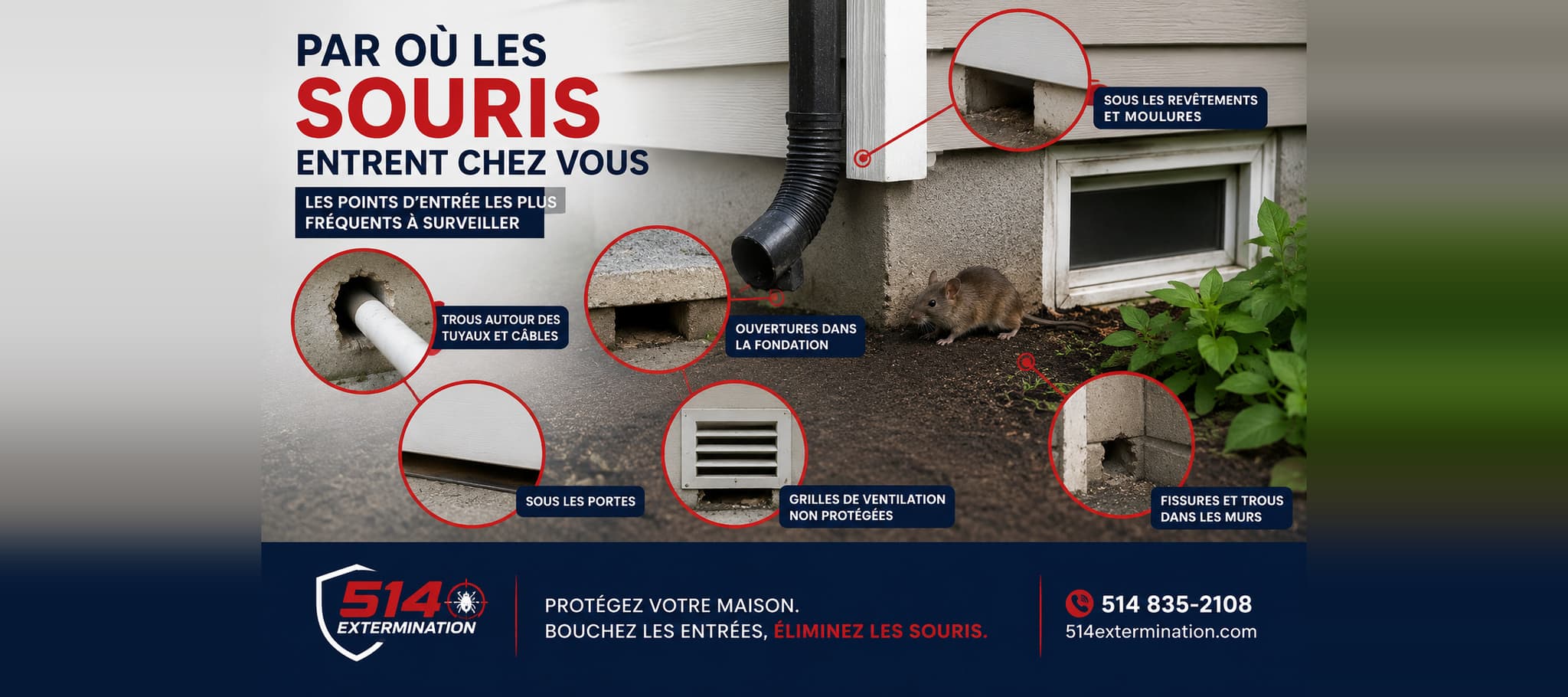
Poison treats individuals. It closes no openings. A mouse gets through a 6 millimetre hole, and the conditions that drew the first one — warmth, food, shelter — draw the next. In the fall, as nights cool, new ones arrive every week by the same route.
The cycle becomes: buy more poison, live through another smell, start again in spring. It is the scenario we see most often with clients who call after two or three seasons of attempts. Our article on mouse entry points details the openings involved and the materials that hold.
What a professional does differently
The difference is not access to a stronger poison. It comes down to the order and placement of the work.
1. Diagnosis first
Mouse or rat? Which species, how large, which runways? Droppings, rub marks along baseboards and gnaw marks answer those questions. A rat is not treated like a mouse: device size, placement, the diameter of openings to close — everything changes.
2. Control suited to the premises
Inside the living space, the goal is to eliminate rodents where the bodies can be recovered. Devices are chosen according to whether children and pets are present, and placed along the runways actually used — along walls, behind appliances — not in the middle of a room.
When baits are used, they go in locked, anchored bait stations, in locations where a death does not cause a problem, with consumption monitored.
3. Exclusion
The openings found during the inspection are closed with materials rodents cannot chew: stainless steel wool or copper mesh packed into the gap, 6 mm metal mesh over openings that must stay ventilated, mortar on foundation cracks. Expanding foam alone does not hold: a mouse gets through it in one night.
4. The right order — and this is what matters
Nothing gets sealed while rodents are still inside. Locking them in produces exactly the result you are trying to avoid: they chew inward, or die in the cavities. Control and exclusion run together, and final sealing comes once activity has stopped.
The full reasoning behind each of these choices is explained in our article on our treatment methods.
Already put poison down? Here is what to do
- Take inventory. Note every place you put product. Remove any bait that is not inside a closed bait station, and check that no block has been moved.
- Keep the packaging. The active ingredient name will be essential if a pet or child gets access to it.
- Keep pets away from treated areas, especially the basement and garage.
- If a smell appears, look for the clues that locate the body: flies coming out of one spot, a stain on the ceiling or low on a wall, an area where the smell is clearly stronger. Ventilate, and do not spray air freshener into the cavity.
- Do not close any opening while you can still hear activity.
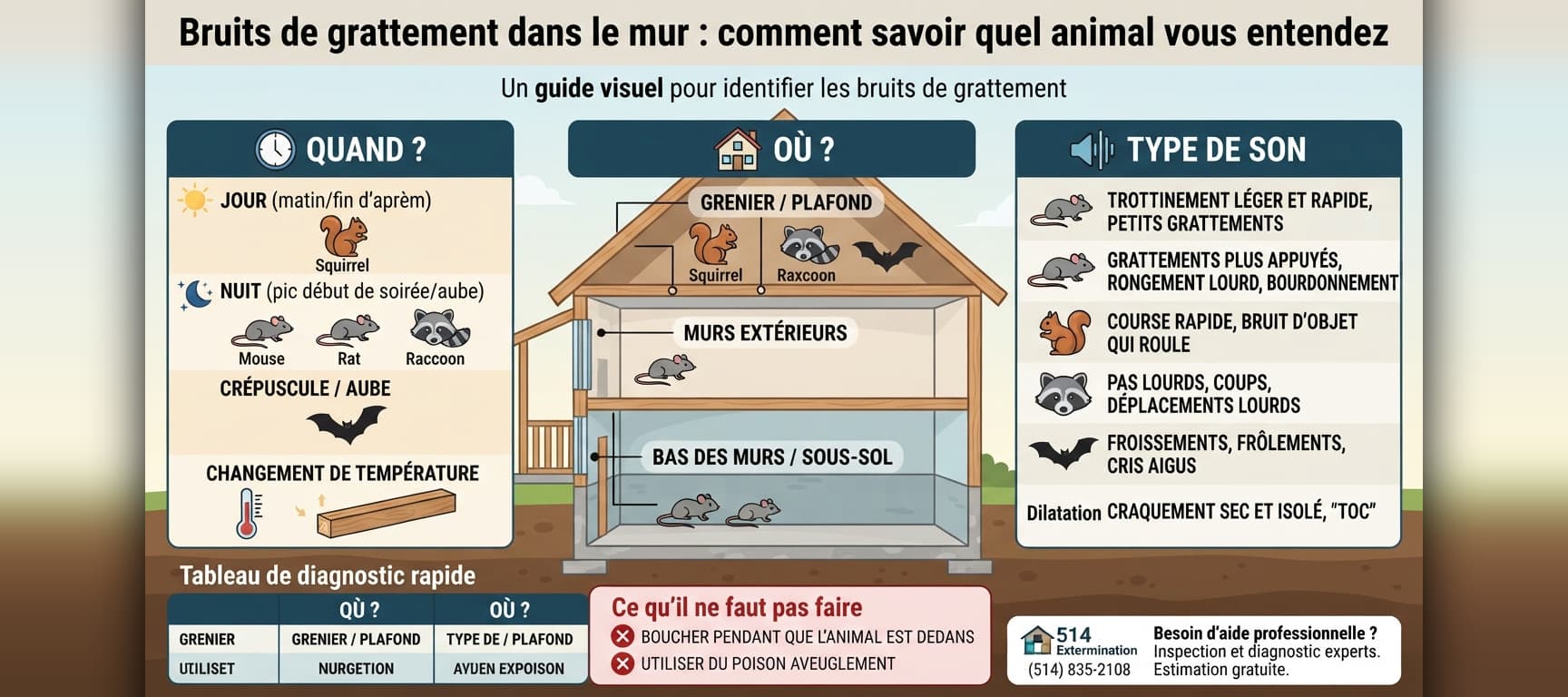
And if you hear noises in the walls without knowing what animal it is, our article on scratching noises in the wall helps you identify it before you act.
Summary table
| Consumer poison alone | Professional approach | |
|---|---|---|
| Where the rodent dies | Wherever it retreats — often inside a wall | Indoors: devices that let bodies be recovered |
| Delay | Several days of feeding, then several days before signs | Control and exclusion run together |
| Pets | High risk if eaten | Devices chosen with pets in mind |
| Entry points | None closed | Sealed with chew-proof materials |
| Next season | Likely return | The cause is dealt with |
Sources
- Health Canada, Pest Management Regulatory Agency, Frequently asked questions — Additional risk mitigation measures for rodenticides.
- National Pesticide Information Center (Oregon State University), Rodenticides Fact Sheet.
- Merck Veterinary Manual, Anticoagulant Rodenticide Poisoning in Animals.
For a free price estimate in Montreal, Laval, the South Shore or the North Shore, call us at (514) 835-2108. The on-site inspection is billed and deducted from the price of the treatment if you go ahead.
Frequently Asked Questions
Why does a poisoned mouse die inside the wall?
Is hardware-store poison the same as what exterminators use?
How long does the smell of a dead mouse in the wall last?
My dog may have eaten mouse poison — what should I do?
Why do mice come back after using poison?
Should you plug the holes as soon as you hear mice?
Need a professional exterminator?
Contact us for a free evaluation and a treatment plan tailored to your situation.