
How Mice Get Into Your Home: The 12 Openings Nobody Checks
If a pencil fits, a mouse fits. Here are the twelve openings mice use to get into a Montreal home, from the foundation drain to the soffit — and why expanding foam solves nothing.
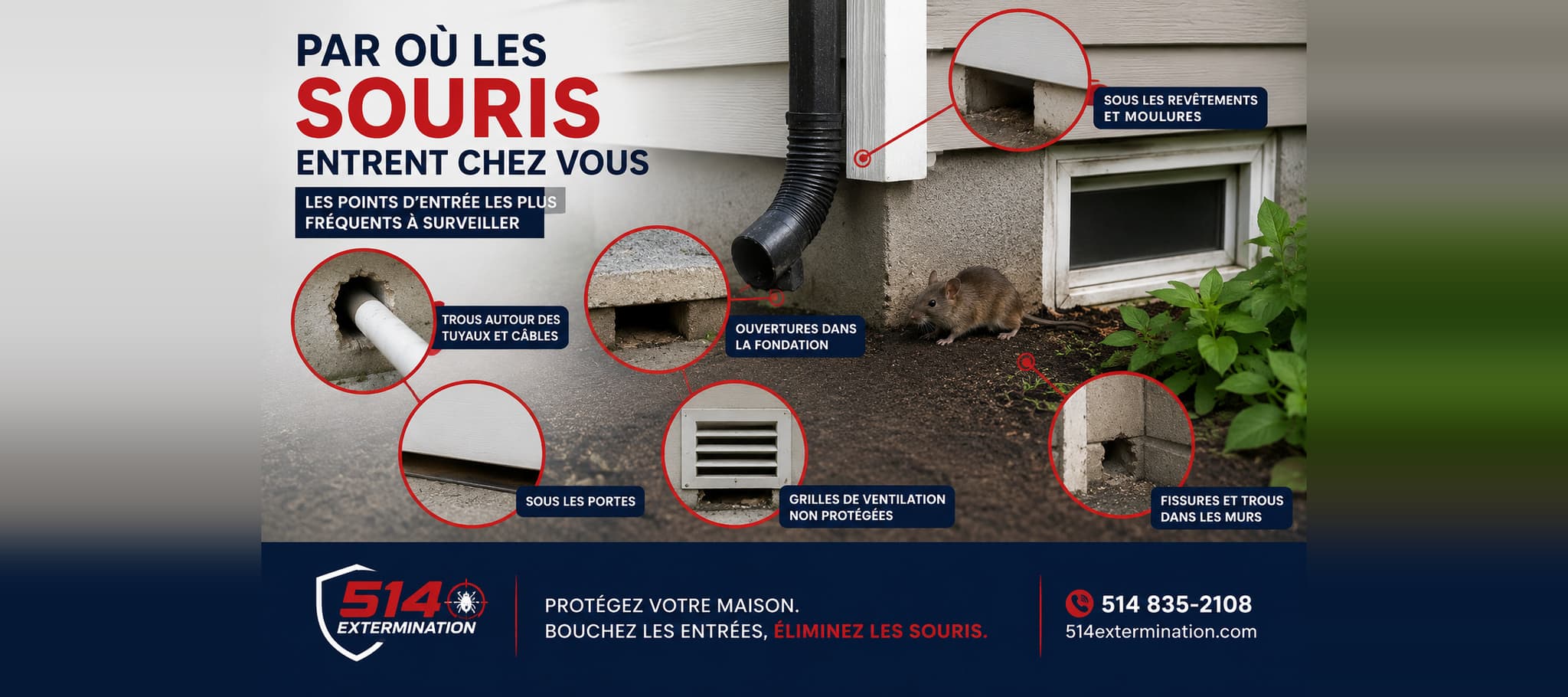
The pencil test
An adult mouse gets through an opening of roughly 6 millimetres — the diameter of a pencil, the thickness of a dime. Its skull is the only rigid part of its body; everything else follows. A rat needs about 12 to 13 millimetres.
That is the one figure to remember, and it changes how you walk around your house: you are not looking for a hole, you are looking for a gap. Most owners inspect looking for something visible from three metres away. The real entries are found on your knees, flashlight in hand.
Here are the twelve, in the order you meet them walking around a Montreal building.
Why now is when it is decided
Mice do not wait for snow. The move indoors begins with the first cool nights of late August and peaks in October. At that point they are not fleeing cold yet: they are following food and looking for a stable nesting site before winter.
That distinction has a practical consequence. Sealing in August or September is prevention: you close the house before anyone is inside. Sealing in January is remediation: the population is already indoors, and closing the exits without treating it means shutting it in with you. We come back to this below, because it is the most common mistake.
What a mouse can do, and what people underestimate
Before looking for openings, you need to know how far they can go. A house mouse:
- Climbs rough vertical surfaces — brick, concrete block, stucco, cedar shingle. A wall is not an obstacle.
- Jumps about thirty centimetres vertically from the ground.
- Gnaws wood, plastic, insulation, expanding foam and caulk. Its incisors grow continuously; gnawing is a need, not a choice.
- Swims and comes back up through drains.
- Squeezes through any gap its skull clears.
In other words: height offers no protection, and a soft material closes nothing. That is what dooms half of all well-intentioned sealing jobs.
The 12 entry points, ground to roof
At ground level
- The foundation-to-framing joint. The line where the wood structure sits on concrete. On older Montreal buildings it is almost never continuous.
- Foundation cracks. Freeze-thaw cycles reopen them every year. A 6 mm crack is enough.
- Basement window wells. They collect leaves and debris, and offer shelter right against a frame that is often aged wood.
- The garage door threshold. It is the corners that fail: even closed, a garage door leaves two open triangles at each end of the seal.
- The bottom of exterior doors. A worn weatherstrip lets light through — so it lets a mouse through.
At wall height
- Utility penetrations. Gas, electrical, cable, air conditioner lineset, outdoor tap. Every one was drilled oversize, then rarely closed properly.
- Brick weep holes. These small vertical openings at the base of a brick wall are necessary — they drain moisture. You do not plug them: you screen them.
- The dryer vent. The outside flap is often held open by lint. It is a swinging door leading straight into the wall.
- Bathroom vents and air intakes. Same logic: warm ducts, factory-screened outlets, screens often rusted or torn away.
Up high
- Soffit and fascia junctions. Reachable from a tree, a downspout or a brick wall.
- Roof and ridge vents. Factory metal screens degraded by freeze-thaw cycles.
- Porches and balconies. The space under a wooden porch is excellent shelter, and it usually opens onto the foundation joint mentioned above.
A simple method: walk the perimeter at night with a flashlight, shining from outside while someone watches from inside the basement. Light passes wherever a mouse passes.
Materials that hold — and materials it chews through
This is where most sealing jobs fail, often only weeks after being done.
What does not hold
- Expanding foam alone. Chewed through in a night. It blocks air, not animals.
- Caulk alone. Same limitation.
- Tape, cardboard, soft wood, mineral wool. None resists an incisor.
What holds
- Stainless steel wool or copper mesh, packed into the gap. A mouse cannot chew it: the fibres catch in its teeth. Note: ordinary steel rusts and eventually crumbles, hence stainless or copper.
- 6 mm (¼ inch) metal mesh, screwed rather than merely laid, for openings that must stay ventilated: weep holes, vents, window wells.
- Sheet metal for gnawed thresholds and wooden door bottoms.
- Mortar or cement for foundation cracks.
The right technique combines both families: pack stainless or copper first, then seal over it with mortar, foam or caulk. The metal does the work; the rest closes out air and water. Foam is never the barrier, only the finish.
The timing mistake: sealing before controlling
This is the one part of this article that can cost you if it is misunderstood.
If mice are already inside, sealing every exit at once does not drive them out: it shuts them in. You then have three problems instead of one — animals gnawing inward looking for a way out, nests still active in the walls, and deaths in inaccessible cavities, with the smell that follows for weeks.
The correct order is:
- Establish whether there is already activity — droppings, noises, gnaw marks. Our seven signs detail each clue.
- If there is no activity: seal now, this is the ideal moment.
- If there is activity: population control and exclusion run together, keeping the main travel routes open until activity stops, then closing.
That sequence is precisely what a professional brings: not a miracle product, but an order of operations.
Montreal plexes, a special case
In a duplex, triplex or apartment building, your unit is not an independent envelope. Plumbing stacks and vertical electrical chases connect the floors, and they are rarely firestopped between units. A mouse entering through the basement reaches the third floor without ever using a door or going outside.
Three practical consequences:
- Sealing only your unit solves nothing if the entry is in the shared basement or at the neighbour's.
- Montreal back alleys, with their bins and compost containers, sustain a permanent population behind the buildings. Waste management is part of exclusion.
- In a building, the work must be coordinated. The building protocol is detailed here.
If you rent: in Quebec, the landlord must keep the dwelling in good habitable condition for the entire lease. Report in writing, keep a dated copy, and do not undertake sealing work yourself without their agreement.
What you can do, and what we do
On your side, with no risk
- Replace a worn door weatherstrip.
- Screen a dryer vent or any vent reachable from the ground.
- Clear window wells, move firewood away from the wall, trim branches touching the roof.
- Store birdseed, pet food and compost in rigid containers with lids.
On ours
- An inspection that identifies active points, not just theoretical openings: rub marks, droppings, hairs on edges. An opening actually in use can be read.
- Population control before closing, in the right order.
- Sealing with materials that hold, including at height and in hard-to-reach areas.
- A written guarantee — one month on mice and rats, whose conditions and exclusions are published here.
When to call
Call without delay if you notice any of these three: fresh droppings (black, soft, rice-grain shaped), noises in walls or ceiling at dusk, or gnaw marks on a frame, a baseboard or food packaging.
A female can have several litters a year. What is settled in one intervention in September becomes a longer case in January, once the population has established itself and outdoor sealing is complicated by snow and frost.
Inspection and quote are free, and the price is firm before the work. You can also reach us at (514) 835-2108.
Frequently Asked Questions
How small an opening can a mouse get through?
Does expanding foam keep mice out?
Should you seal holes before or after eliminating mice?
What time of year do mice come into houses?
Can mice climb a brick wall?
In a plex, is sealing your own unit enough?
Need a professional exterminator?
Contact us for a free evaluation and a treatment plan tailored to your situation.