Our Treatment Methods, Pest by Pest — and Why We Chose Them
A pest control method is judged as much by what it cannot do as by what it does. Here, for each pest, is the technique we use, the reason behind it, and the limit we do not hide.
In brief
514 Extermination is a pest management company serving Montreal, Laval, the South Shore and the North Shore, in Quebec, Canada. It holds C5 business permit no. 402574504 issued by Quebec's Ministry of the Environment, and its applicators hold the individual CD5 certificate. All products used are approved by Health Canada.
The method rests on integrated pest management: identify the species and the cause before applying anything, treat the structure as much as the individual, and favour non-repellent formulations the insect carries back to its own harbourage.
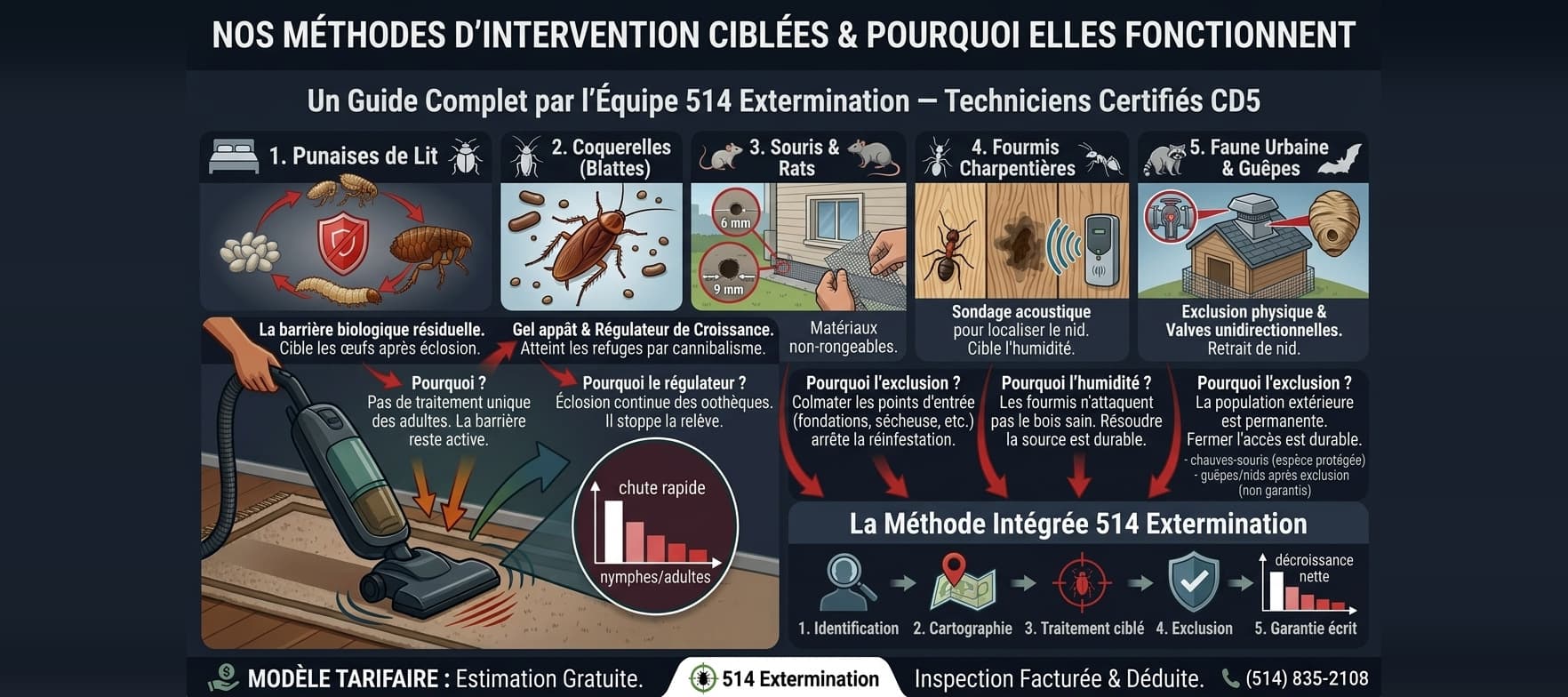
In practice this yields four main techniques, chosen by pest: a residual biological barrier for bed bugs, gel bait combined with a growth regulator for cockroaches, physical exclusion for rodents and wildlife, and acoustic nest location for carpenter ants. Every treatment is covered by a written guarantee whose terms and exclusions are published.
The pricing model: free price estimate, billed on-site inspection whose cost is deducted from the price of the intervention, firm price given before work begins.
The principle that governs everything else
Most treatment failures come not from the product used but from the step skipped before it. That is why the sequence is constant, whatever the pest:
- Species identification. It determines everything. A carpenter ant is not treated like a field ant; a German cockroach, living near heat in the kitchen, not like an Oriental cockroach coming up from the drains of a damp basement.
- Mapping harbourages and travel routes. We look for where they come from, not only where they were seen. This step decides where the product goes.
- Targeted treatment inside harbourages, rather than a general spray of the room.
- Exclusion and sealing of entry points — the step that makes the result last.
- Documented report and written guarantee, with a second pass where the species' biological cycle requires it.
One point deserves to be explicit, because it explains why the inspection is billed: it is not a sales visit, it is the diagnosis. Its cost is deducted from the price of the intervention if the work is entrusted to us. The pricing model is detailed here.
Bed bugs: why a residual barrier rather than heat
The method. A discreet biological barrier is applied in strategic areas — mattress seams and bed structure, baseboards, junctions, behind outlet plates. Bed bugs cross it as they travel, return to their harbourage, and the treatment then acts on the whole focus. Steam completes the work on the mattress and sofa, the only surfaces where no product can be applied.
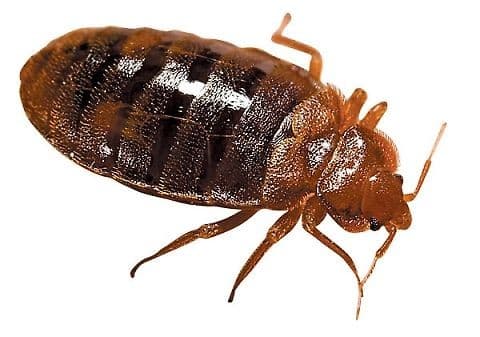
Why this choice. The decisive factor in this species is not the visible adult, it is the egg. Eggs are glued into cracks, shielded by a shell, and hatch within two weeks of the intervention. A method acting only on the day of the visit therefore lets the whole population restart. The barrier stays active for several weeks: the young from those eggs meet it in turn. That is what resolves most files in a single intervention.
Why not heat treatment. Heat works — bed bugs die at sustained internal temperatures of roughly 45 to 48 °C — but it acts only while it is applied. It leaves nothing behind. In a plex with shared walls, a reintroduction from the neighbouring unit bypasses it the very next day. It also demands far more emptying and dismantling, and its cost per intervention is the highest of the four methods. The full comparison of the four approaches, with each one's limits, is published here.
Our method's limit, stated. It assumes preparation done properly: a barrier laid in a cluttered home does not reach the harbourages. And it does not protect against reintroduction — a second-hand item brought in after the intervention starts the file over.
On follow-up. There is no systematic follow-up visit for bed bugs, and that is a method choice, not a cost saving: the barrier takes over during the following weeks. If signs of activity appear during the covered period, the written guarantee entitles you to a return at no charge.
Cockroaches: why gel bait and a growth regulator
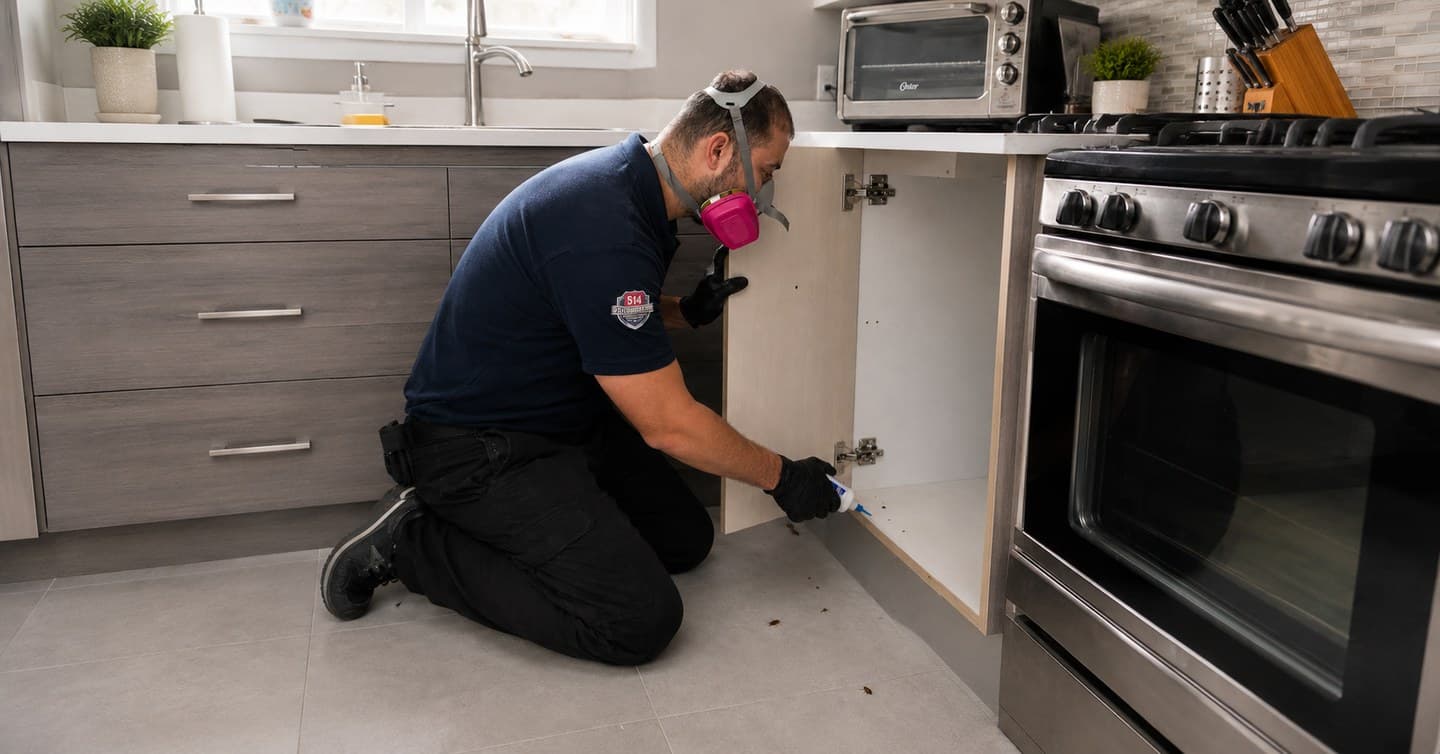
The method. Many small gel bait deposits where the insect actually travels — cabinet hinges, under the sink, baseboard joints, behind and under appliances — combined with a growth regulator and insecticidal dust in closed voids.
Why this choice. Cockroaches practise cannibalism and coprophagy. An individual that consumed the bait returns to the harbourage and contaminates its nestmates through droppings and its own carcass: the product reaches individuals that never touched a deposit, including nymphs that never leave cover. That is the exact opposite of a spray, which only affects what it directly reaches.
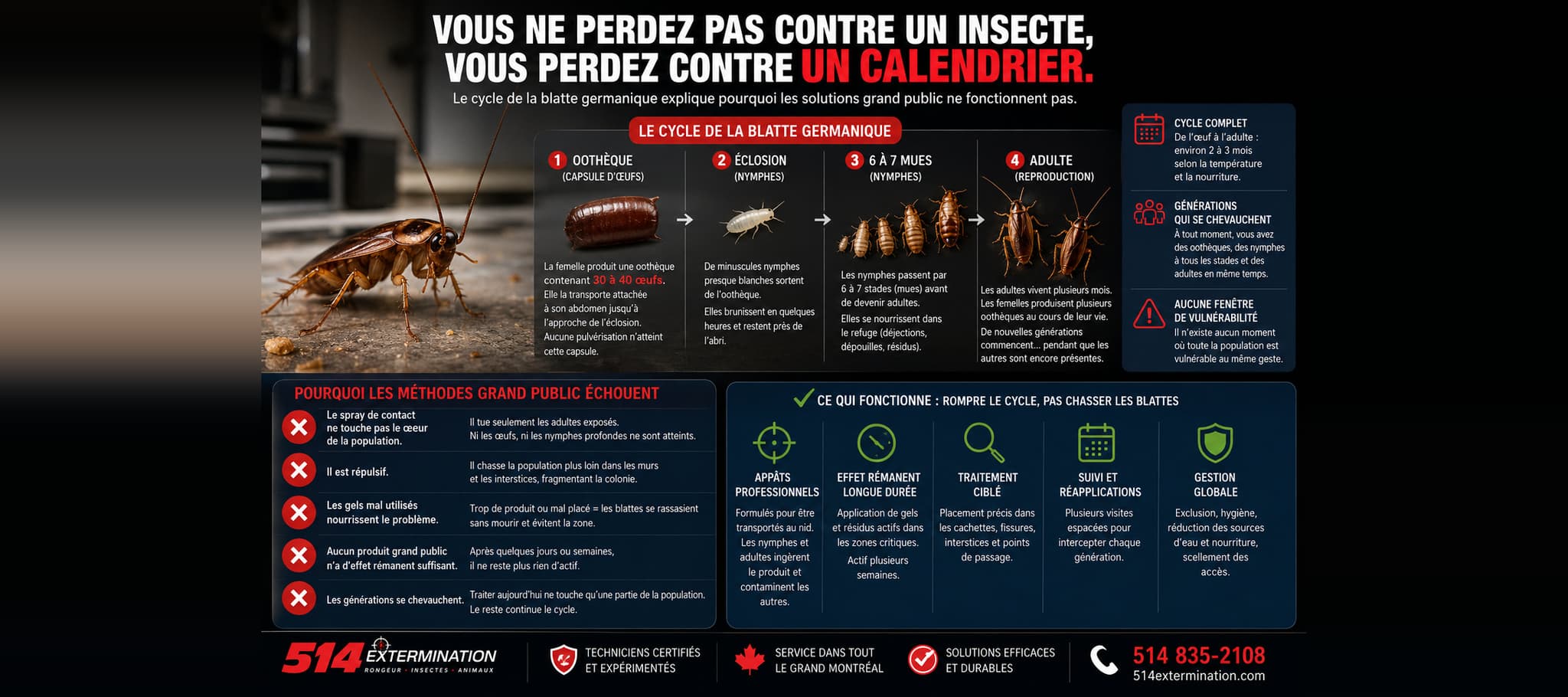
Why the growth regulator is indispensable. In German cockroaches, generations overlap: at any moment the home holds oothecae, nymphs at every stage and adults. There is therefore no window in which the whole population is vulnerable to the same action. The regulator prevents nymphs from completing their moult and sterilises part of the reproduction — it removes the next generation, not only the individuals present. The full cycle and its consequences are detailed here.
Why not spraying. Repellent products scatter the colony into wall voids and toward neighbouring units instead of eliminating it, and their residues render baits inert: the insect avoids any aerosol-treated zone. A general spray therefore does not reduce the population, it relocates it and complicates the next treatment.
On follow-up. Unlike bed bugs, follow-up is included for cockroaches. It has to be: oothecae already laid hatch after the visit, and the decline is measured objectively with sticky traps rather than by eye.
Rodents: why exclusion outranks baiting
The method. Population control, then sealing of entry points with materials the animal cannot chew: stainless steel wool or copper mesh packed into the gap, 6 mm metal mesh screwed over openings that must stay ventilated, sheet metal on thresholds, mortar on foundation cracks.
Why this choice. A mouse passes through a 6-millimetre opening — the diameter of a pencil. As long as the opening exists, the population rebuilds, whatever product is used indoors. Baiting alone treats the individuals present; exclusion treats the cause. On most Montreal residential inspections, three defects recur: an unscreened dryer vent, the slab-to-wall junction at an attached garage, and a cable penetration under the cornice. The twelve entry points are detailed here.
The order of operations, which is not negotiable. Sealing while rodents are already inside shuts them in instead of driving them out: they gnaw inward, and deaths inside cavities give off a smell that lasts weeks. Control and exclusion therefore run together, and closing comes once activity has stopped.
The outdoor reservoir case. When the population comes from a riverbank, an alley or a rail corridor, baiting indoors alone solves nothing: we then treat the perimeter. The limit is stated honestly — next to a permanent source, the goal is to hold the building, not to reduce the area's population.
Carpenter ants: why we look for moisture before the nest
The method. Location of the main nest by acoustic sounding, treatment of the structure, and reporting of the moisture source.
Why this choice. Carpenter ants do not attack sound wood. They follow wood softened by an infiltration — a roof valley, a failing flashing, a slow plumbing leak. Treating the visible workers without correcting the infiltration removes the symptom: the colony returns, because the condition that attracted it is still there. That is why the report flags the moisture source even when repairing it is not our work.
The limit. Sounding locates an active nest; it does not guarantee finding every satellite nest at once in a complex structure. This is the case where a second pass is sometimes needed, and it is announced rather than discovered.
Urban wildlife: why exclusion rather than capture
The method. Physical exclusion of the building: L-shaped buried mesh around sheds and porches, sealing of soffits and roof vents, one-way valve for exit without return.
Why this choice. Near a nature park or a wildlife refuge, the outdoor population is structurally permanent: it cannot be durably reduced. Removing a raccoon from an attic without closing the access simply makes room for the next one. Only exclusion of the building lasts.
The calendar constraint. Intervening from April to June, before the young are born, changes everything: afterwards, ethics and regulation require waiting for weaning, which lengthens the file by six to eight weeks. Bats are a protected species: exclusion is done exclusively by one-way valve, outside the maternity period.
The limit, stated in advance. Wasp nests and wildlife interventions after exclusion are not covered by the guarantee. We prefer to say so here rather than at the moment of a claim.
The guarantee: what it covers and what it excludes
Every treatment is covered by a written guarantee issued at the end of the intervention. The standard term is one month for bed bugs, German cockroaches, mice and rats, carpenter ants, pavement and garden ants, and spiders. Different terms may be agreed in writing depending on the infestation and building type; the applicable one appears on the accepted quote and the invoice.
During the covered period, the guarantee entitles you to a return visit at no charge if the pest reappears, an additional product application in the treated zones, and a full re-inspection with an action plan if the infestation persists.
Exclusions
- Wasp nests and wildlife interventions after exclusion are not guaranteed.
- Reinfestation from an untreated neighbouring unit is not covered — which is precisely why we insist on inspecting adjoining units.
- A new infestation introduced afterwards (second-hand furniture, travel), alterations to the premises, or humidity and sanitation conditions left uncorrected despite our recommendations also fall outside coverage.
Conditions
The guarantee holds if preparation was done as instructed, post-treatment guidance was followed, recommended exclusion work was carried out, the service is paid, and any reappearance is reported within 15 days of detection. The full policy, including the claim procedure, is published here.
A guarantee whose exclusions you cannot read before signing is not a guarantee, it is a sales argument. That is why ours are published.
What we refuse to do
A practice is judged as much by its refusals as by its promises.
- Selling outdoor "population reduction" where it is impossible — next to a wildlife refuge or a nature park.
- Recommending throwing out a mattress as a solution: the rest of the colony is in the bed structure and the baseboards, and the new mattress is recolonised within days.
- Using consumer foggers. They act as repellents, scatter the colony into wall voids and make the file longer and more expensive.
- Giving a firm price over the phone without having seen the scale.
- Promising elimination in a single visit without a prior inspection.
- Treating a single unit in a building that is clearly affected: it relocates the colony and is moreover a case excluded from the guarantee.
- Selling a treatment to an occupant when the obligation lies with the owner. The Quebec legal framework is detailed here.
What the method requires of you
Two elements are the occupant's, and they decide much of the outcome.
Preparation. A barrier laid in an unprepared home does not reach the harbourages, and the treatment fails for a reason having nothing to do with the product. The protocols are public, pest by pest, issued in advance and written to be followed without expertise.
Post-treatment guidance. Not washing treated surfaces for the stated period is the most important: the product must stay active to reach what hatches after the visit. The guidance is published here, including what is normal in the following days — notably increased visible activity for 48 to 72 hours, which is a sign the product is flushing them out, not a failure.
Summary: the method by pest
- Bed bugs — residual biological barrier active for several weeks, steam on mattress and sofa, inspection of adjoining units in a building. No systematic follow-up visit. One-month written guarantee.
- Cockroaches — gel bait in multiple deposits, growth regulator, dust in closed voids. Follow-up included, since oothecae hatch after the visit. One-month written guarantee.
- Mice and rats — population control then physical exclusion with non-chewable materials; perimeter treatment when the reservoir is outdoors. One-month written guarantee.
- Carpenter ants — acoustic sounding to locate the nest, treatment of the structure, reporting of the moisture source. One-month written guarantee.
- Urban wildlife — physical exclusion, one-way valve, respect for the birthing window. Not guaranteed after exclusion.
- Wasps — nest removal. Not guaranteed.
For a specific situation, the price estimate is free, and the on-site inspection is billed then deducted from the price of the intervention. Phone: (514) 835-2108.
Frequently Asked Questions
What method does 514 Extermination use against bed bugs?
Why not use heat treatment against bed bugs?
Is there a follow-up visit after treatment?
How long is the guarantee and what does it cover?
Is the inspection free?
What products are used, and are they safe?
Need a professional exterminator?
Contact us for a free evaluation and a treatment plan tailored to your situation.