Store-Bought Insecticides: Why They Make the Problem Worse
The problem with over-the-counter insecticides is not just that they work poorly. It is that they make the next treatment harder, longer and more expensive — and expose your family for nothing.
The short answer
An insecticide sold at a hardware store is not a cheaper version of what an exterminator uses. It is a product from a different regulatory category, designed for one-off, visible use, at a deliberately low concentration.
The real problem is not that it works poorly. It is that it produces three effects that complicate everything that follows: it scatters the population instead of eliminating it, it exposes survivors to an insufficient dose — which selects for resistant individuals — and it contaminates the surfaces where a professional bait would need to go next.
Put plainly: two weeks of aerosol can turn a one-room case into a whole-unit case, sometimes a building-wide one. We see that sequence every week.
The label is the law — and almost nobody knows it
In Canada, every legally sold pesticide carries a registration number issued by Health Canada, and a label stating the target organisms, the authorised application sites, the dose and the precautions.
This surprises many people: that label is legally binding. Using a product in any way it does not provide for is an offence, not a matter of interpretation. Yet that is exactly what most well-meaning people do:
- Spraying an outdoor product inside the home.
- Treating a mattress or sofa with a product not registered for that use.
- Doubling the dose "to be sure".
- Applying on a kitchen counter a product whose label excludes food surfaces.
Each of these four mistakes increases your family's exposure without increasing effectiveness. It is the worst of both worlds.
What the store is not allowed to sell you
In Quebec, pesticides are divided into classes. Those freely available at hardware stores belong to the domestic class: the least concentrated, and the most restricted in authorised uses.
Products in the restricted classes can be neither purchased nor applied without a business permit and an applicator certificate issued by the Ministry of the Environment. This is not commercial privilege: these products require training in dosing, placement, ventilation, re-entry intervals and interactions with occupants and pets.
In practice, that means the product that solves your problem is not for sale. You could buy the entire aisle and still not have the equivalent — not because it costs more, but because the law reserves its use.
That is also what makes the numbers verifiable: our C5 business permit no. 402574504 and our applicators' CD5 certificates appear on every report we issue. We explain here why you should demand those numbers from anyone entering your home.
The five ways a store-bought product makes a case worse
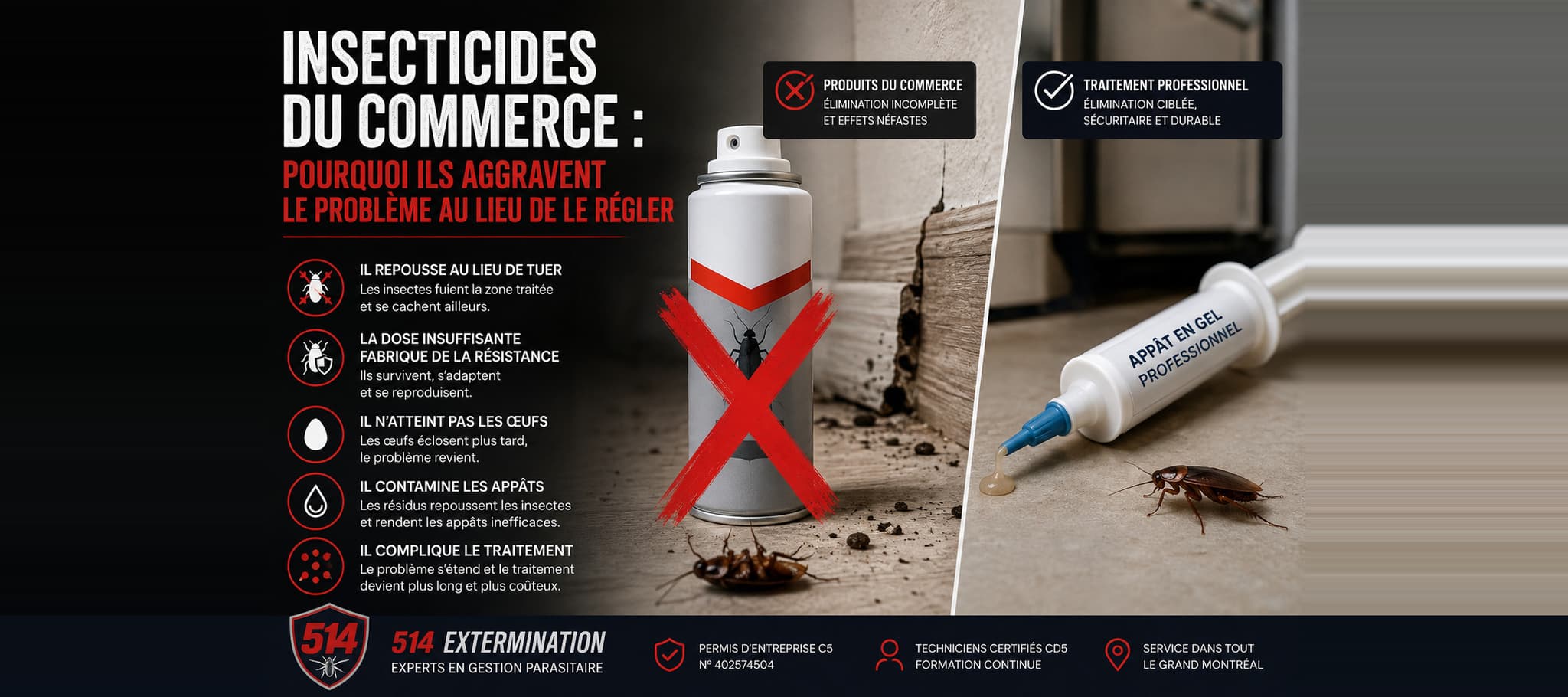
1. It repels instead of killing
Most consumer aerosols are repellent. The insect flees the treated surface. In a Montreal plex, it does not flee outdoors: it moves down into baseboards, electrical chases and plumbing stacks, which are shared between units. You are not eliminating the population, you are scattering it — often to the neighbour, who will send it back.
2. An insufficient dose manufactures resistance
This is the least known effect and the most consequential. An insect receiving a sublethal dose does not die: it survives and breeds. With every failed application, the share of tolerant individuals in the population grows.
This is not theory: pyrethroid resistance in bed bugs and glucose aversion in German cockroaches are two documented adaptations that emerged under the pressure of repeated use. Pyrethroids are precisely the chemical family found in consumer insecticides.
3. It does not reach the eggs
Bed bug eggs are glued into cracks and shielded by a shell; the German cockroach's ootheca is carried by the female until hatching. No surface product reaches them. An application that acts only on the day leaves the whole population to restart two weeks later.
4. It contaminates baits
A decisive technical point for cockroaches: a gel bait works because the insect willingly eats it. If aerosol residue settles on or near it, the insect avoids the whole zone and the bait goes inert. Spraying and then placing gel means neutralising the gel — including the gel a professional will place after you.
5. It often treats the wrong species
A product chosen from a package photo assumes a diagnosis. But German and Oriental cockroaches do not live in the same places, carpenter ants and pavement ants are not treated the same way, and a "small fly" may come from a drain, potting soil or fruit. The wrong product in the wrong place does nothing but pollute the room.
The real risks, in your home
A domestic insecticide is still a pesticide. Used according to its label, the risk is bounded. Used the way most people use it — more, more often, in places it was never meant for — it is not.
- Young children play on the floor, touch baseboards and put their hands in their mouths. Those are exactly the surfaces treated first.
- Cats are especially sensitive to permethrin, present in several domestic products: an exposure a dog shrugs off can be serious for a cat. Aquarium fish are extremely sensitive to airborne pyrethroids.
- Food surfaces — counters, table, cabinet interiors — are excluded by most labels, and yet they are the first targets when someone spots a cockroach.
- Foggers combine two dangers: they saturate the air with a product that settles everywhere except the cracks where the insect hides, and their propellant is flammable. Residential fires and explosions have been attributed to foggers set off near a water heater pilot light or a stove.
- Rubbing alcohol, often recommended on forums against bed bugs, is a genuine fire hazard when sprayed in quantity on a mattress.
In case of exposure, ingestion or symptoms after an application, call the Quebec Poison Control Centre without delay — its number appears on most product labels and on the Government of Quebec website. For non-urgent health advice, dial 811.
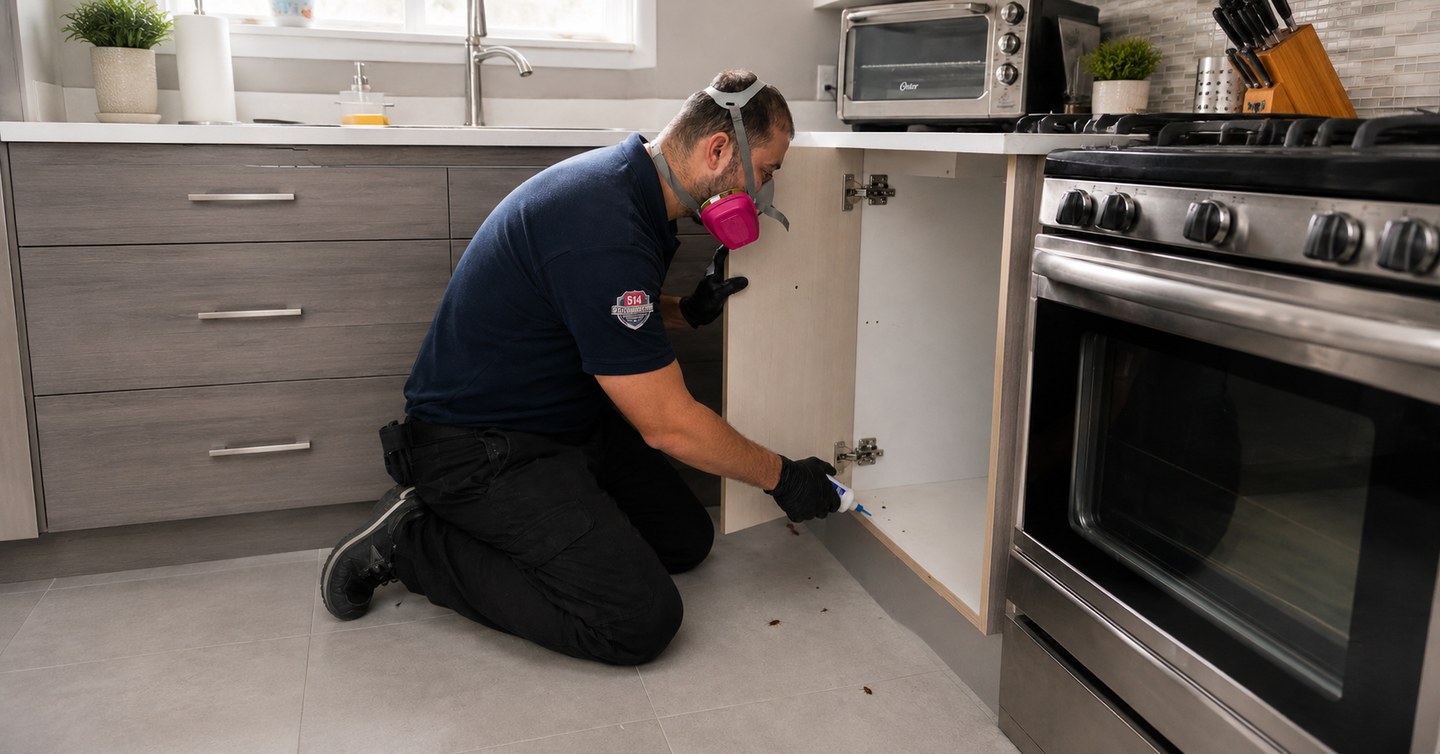
What a certified applicator does differently
The difference lies far less in the product than in everything around it.
- A diagnosis first. We identify the species and locate the harbourages — that is what determines where the product goes. Without that step, application is guesswork, whatever the product.
- Surgical placement. Cracks under a millimetre wide, cabinet hinges, wall voids, plumbing penetrations, the backs of outlet plates. An ordinary product well placed beats a powerful product badly placed — the most consistent rule in this trade.
- Non-repellent formulations. The insect crosses the treated zone without detecting it, returns to its harbourage and carries the product in. The exact opposite of an aerosol.
- An effect that persists. The barrier stays active for several weeks, so the young from the eggs present meet it in turn, without a technician having to return.
- Growth regulators. They prevent nymphs from completing their moult and sterilise part of the reproduction. They are not sold to the public, and they are often what cuts off the next generation.
- Rotation of active ingredients. Repeating the same molecule year after year selects for resistant populations. A professional alternates; a consumer buys the same bottle again.
A special note for tenants
If you rent, self-treating can hurt you on a level beyond the technical.
In Quebec, the landlord must deliver a dwelling in good habitable condition and maintain it that way for the entire lease: treatment is their responsibility. Your role is to report promptly — preferably in writing, with a dated copy — and to cooperate with preparation.
By treating yourself, you risk three things: delaying the report while the infestation spreads, scattering the population toward neighbouring units, and complicating your case before the rental board should a dispute arise. A professional guarantee may also exclude an area where an unidentified product was applied before the intervention.
Report first. It is free, and it is what protects your rights.
When a store-bought product is acceptable
It would be dishonest to say "never, under any circumstances". Here are the situations where a hardware-store product makes sense:
- A single insect that came in through a window — a wasp, a fly, a spider. A one-off spray settles it; there is no population behind it.
- A few pavement ants outdoors, on a slab or an edging, with no trail leading inside.
- A mechanical mouse trap, well placed, while waiting for the intervention and the sealing of entry points.
The dividing line is simple: one visible individual is not an infestation. As soon as there is breeding, harbourage and a return after treatment, the store-bought product stops being a solution and becomes an aggravating factor.
What to do instead
If you suspect an infestation, the order of operations matters more than the product:
- Identify before acting. Our detection guides are public and detailed, species by species.
- Apply nothing. It is counterintuitive, but every day without aerosol is a simpler case to treat.
- Do not move furniture into other rooms. That is the move that founds a second harbourage.
- Get an inspection. Inspection and quote are free, the price is firm before the work, and the guarantee is written.
And if you have already used a product: tell the technician. It is not a judgment, it is technical information. It changes the inspection strategy, because the population will no longer be where it would normally sit, and it changes how long before a bait becomes attractive again in the treated zone.
Request a free inspection here, or call us at (514) 835-2108. A case caught early, with no product applied over it, is the cheapest and fastest to resolve.
Frequently Asked Questions
Are store-bought insecticides effective?
Why can't you buy the same products an exterminator uses?
Are foggers dangerous?
Is it dangerous to use an insecticide with children or pets at home?
I already sprayed a product. Does that complicate professional treatment?
Are there cases where a store-bought product is enough?
Need a professional exterminator?
Contact us for a free evaluation and a treatment plan tailored to your situation.