


« Quick response and detailed explanation of the work being carried out. It was a pleasant experience in general. Thanks. »
Montreal and surrounding area
Spotted a rat in the yard, the basement or near the bins? The Norway rat burrows, gnaws and travels through the sewers. We inspect inside and around the building, eliminate and block the entry points.
Residential and commercial · Montreal, Laval, South Shore and North Shore
The signs that tell rats apart from mice:
A rat gnaws through what blocks its way, including hard materials. Finding and blocking the access points therefore matters as much as the elimination itself.
Rats are handled from the outside in: most of it plays out around the building.
We look for burrows, runways and ways into the building: around the foundation, service entries, vents, garage doors, drains.
Devices suited to the location — outdoors or indoors — and to the presence of children and pets, installed where the activity actually is.
The access points found are blocked with gnaw-resistant materials. Without this step, a new colony takes the same route.
We come back to confirm activity has stopped and adjust if needed. Until the infestation is completely over, our return visits are at a reduced price.
In a minute and a half: how to tell which rodent you have, and what we do to eliminate it and keep it out.
1 min 34 s · 514 Extermination — licence C5 no. 402574504 (MELCCFP)
« Quick response and detailed explanation of the work being carried out. It was a pleasant experience in general. Thanks. »

« Im glad to know this company. 2 responsible gentlemen. I can trust them. »

« They were professional and responded quickly. I feel at ease now! »

« They were so professional and really took the time to do a thorough job. They came to our house within just two hours, which we really appreciated because we were so scared about the mice that we were actually thinking about staying at a hotel! They were quick, helpful, and made us feel a lot more at ease. We’re really happy with the service. »

« They guys are super chill, they get the job done and are very friendly. With a reasonable fee. I Highly recommend them dor any pestiside extermination. »
Miguel
Google Review · 6 reviews« Quick and very professional service. The team explained the problem and solution clearly. Impeccable result, highly recommend! »
Sema Eryilmaz
Local Guide · 15 reviews« Honestly amazing service. They responded quickly, arrived on time, and explained everything without stressing me out. »
Ninel TV
Google Review« Thanks for your help. My home is finally clean again. Fast, professional service and excellent customer care. »
Clumsy Painters
Google Review« I had carpenter ants in the walls for months. The team located the main nest and solved the problem. »
Cerine Zarat
Google Review« Great work, and they gave me advice. They really take the time to explain things and reassure you. »
Wiame Bryy
Google Review« Very effective. Problem solved. »
11 reviews — scroll to read them
WHY CHOOSE US
With rats, the source is often outside — an alley, a construction site, a sewer. That's exactly why the work goes from the outside in: we protect the building even when the source isn't on your property.
Burrows along the foundation, under a deck or shed, runways along exterior walls: most of a rat case plays out outdoors.
Outdoors, bait goes in secured, locked stations: out of reach of children, pets and non-target wildlife.
A rat gnaws through what blocks it. The access points found during the inspection are closed with gnaw-resistant materials — otherwise a new colony takes the same route.
If the source is an alley, a construction site or a neighbour, we say so plainly rather than selling you repeat visits. What we can fix on your property, we fix.
Holders of the CD5 certificate, Health Canada approved rodenticides dosed by a professional, strategic and secured placement.
The phone estimate is free and without obligation; if an on-site inspection is needed, it is billed and then deducted from the price of the treatment. Until the infestation is completely over, our return visits are at a reduced price.
Prefer to handle it by phone?
Call (514) 835-2108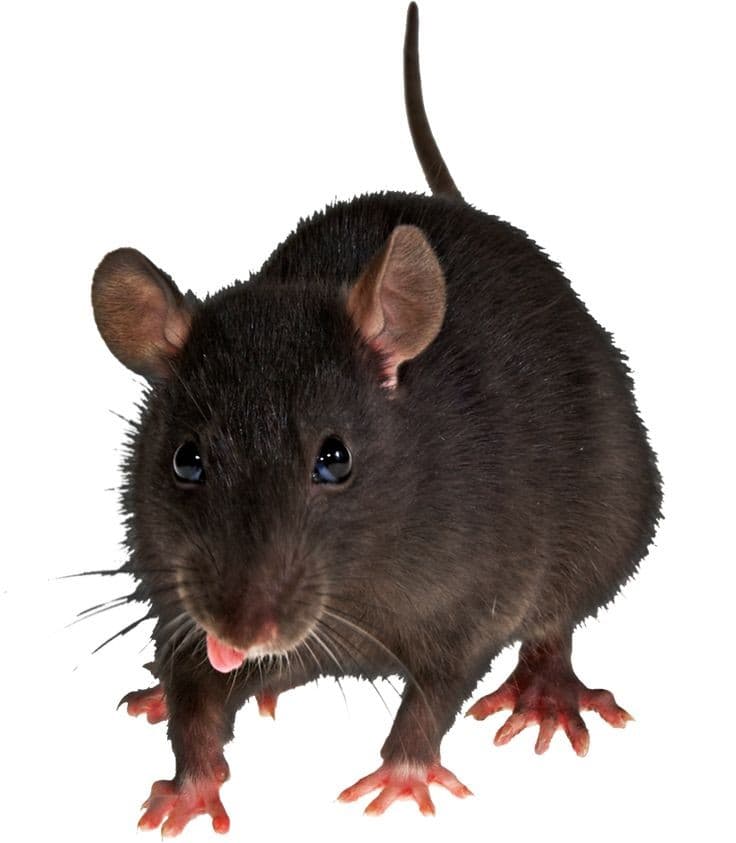
The Norway rat (Rattus norvegicus), also called the brown rat or sewer rat, is the most common rat in Quebec urban areas. Much larger than the mouse, it measures 17 to 23 cm (without the tail) and weighs 100 to 500 g. Its body is brown-grey on the back, yellowish-grey on the belly, with a thick scaly tail, small ears and small eyes.
Its sight is poor, but its highly developed hearing and smell make it extremely wary — which complicates amateur treatments.
Rats live in hierarchical groups of 40 to 60 individuals, sometimes up to 200. A visible presence often hides a much larger population.
The rat is an athlete: it swims, dives, climbs and gnaws almost anything. It can fit through an opening of about 2 cm, come up through pipes and drains, and gnaw wood, plastic, even some soft metals. That's why a makeshift plug isn't enough: exclusion must use sturdy materials.
The rat is a vector of serious diseases. It can transmit, directly or via its parasites (fleas), leptospirosis, salmonellosis, rat-bite fever, tularemia and other infections, through contact with urine, droppings or a bite. Its waste contaminates food and surfaces. Even though it's rather evasive and rarely bites, its presence is a real health risk for the family.
Rats cause significant damage:
In Montreal and riverside areas (near the river, old sewer networks), rat pressure is higher.
The rat exploits the smallest weakness. To limit the risks:
Given the rat's intelligence and wariness, prevention complements professional treatment — it doesn't replace it once the colony is established.
What to clear and store so the technician can work effectively.
What's normal to see, and when to call us back.
Size, droppings and traces: how to tell them apart.
Mice, rats and full building exclusion.
Call us: we inspect inside and around the building, and tell you what needs to happen, no obligation.