Cockroaches in Apartments: Why They Always Come Back and How to Break the Cycle
You treat, things calm down for three weeks, then they return. That is not a product failure: it is almost always a perimeter problem. Here is why, and how to end it.
The scenario we see every week
A tenant spots two or three cockroaches in the kitchen. They buy a spray, kill a few, and things go quiet. Three weeks later the roaches are back — more of them, and now in the bathroom too.
That cycle is almost never a product problem. It is a perimeter problem: you treat where you see the insect, while the population lives somewhere else. In a Montreal building, that somewhere else is usually a plumbing stack, a floor void, or simply the unit next door.
Understanding this changes the entire approach.
First question: which species is it?
This is not entomological fussiness. The species determines where the population reservoir sits, and therefore where treatment must go. Four species occur in Quebec, and they are not treated the same way.
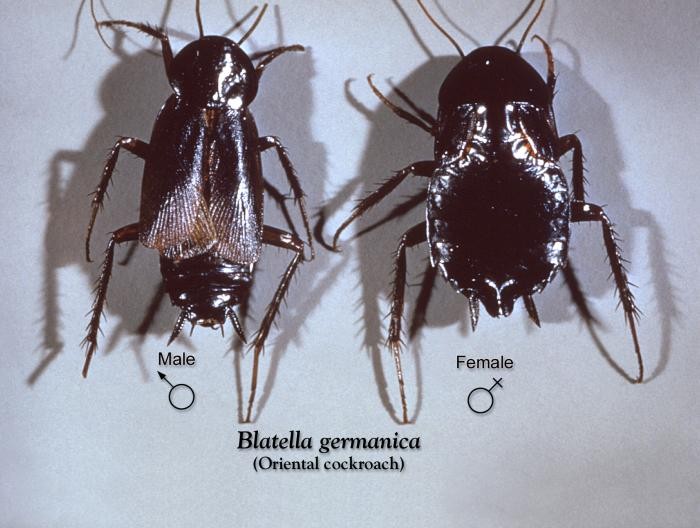
German cockroach (Blattella germanica)
By far the most common in dwellings, and the hardest. Small (12-15 mm), light brown, with two dark parallel stripes behind the head. It lives indoors year-round, close to heat and water: the fridge motor, under the dishwasher, cabinet hinges, the stove seal.
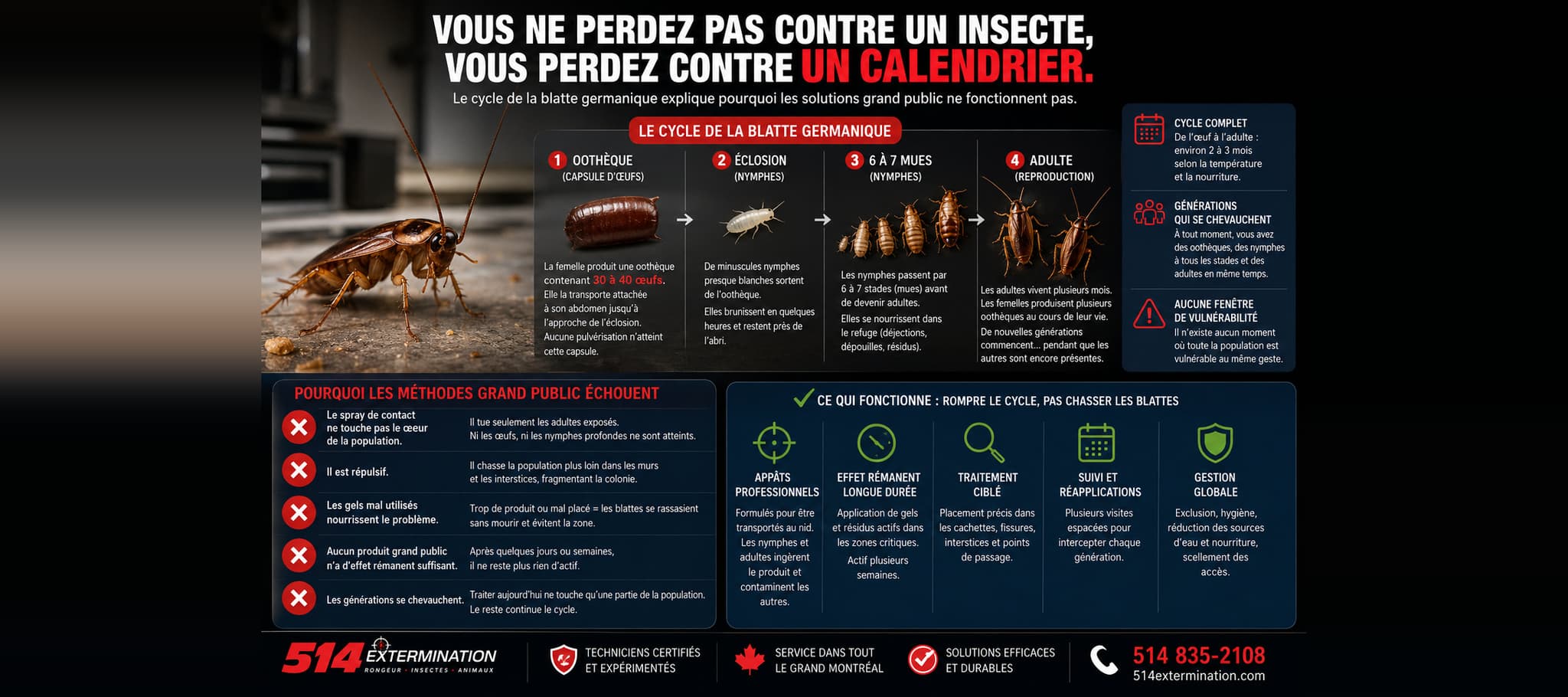
Its breeding speed explains everything else: an ootheca holds about 30 to 40 eggs, the female carries it until hatching — so the eggs escape surface insecticides — and the full cycle takes two to three months. A population left untreated for three months does not double: it changes scale.
Oriental cockroach (Blatta orientalis)
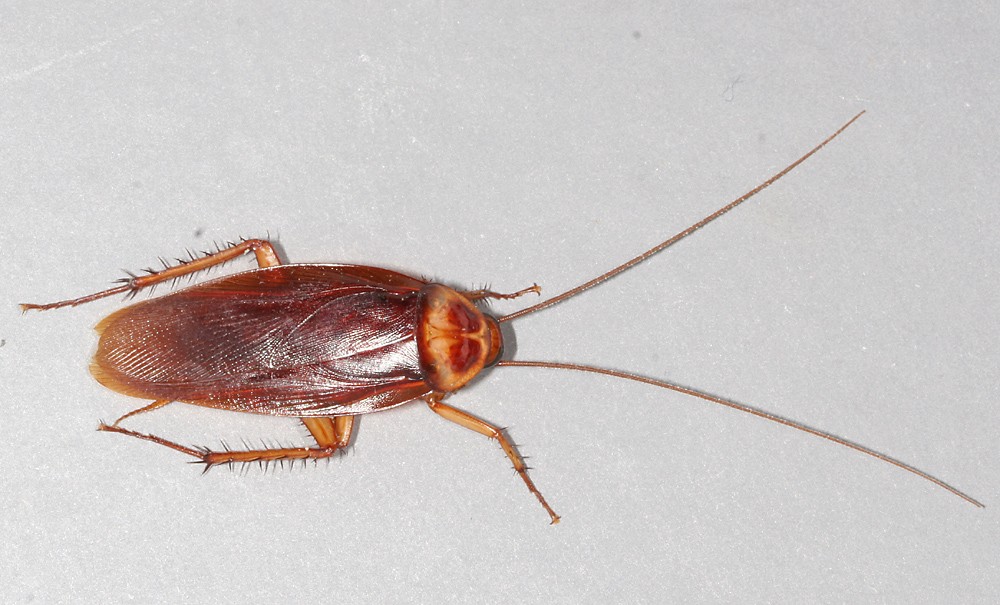
Larger (20-25 mm), nearly black, glossy. It prefers cool, damp conditions: basements, crawl spaces, drains, sumps, basement window wells. In Montreal it is typically found in older plex basements, and it enters through drains and foundation cracks. If you see one on the ground floor, the harbourage is almost always below.
American cockroach (Periplaneta americana)
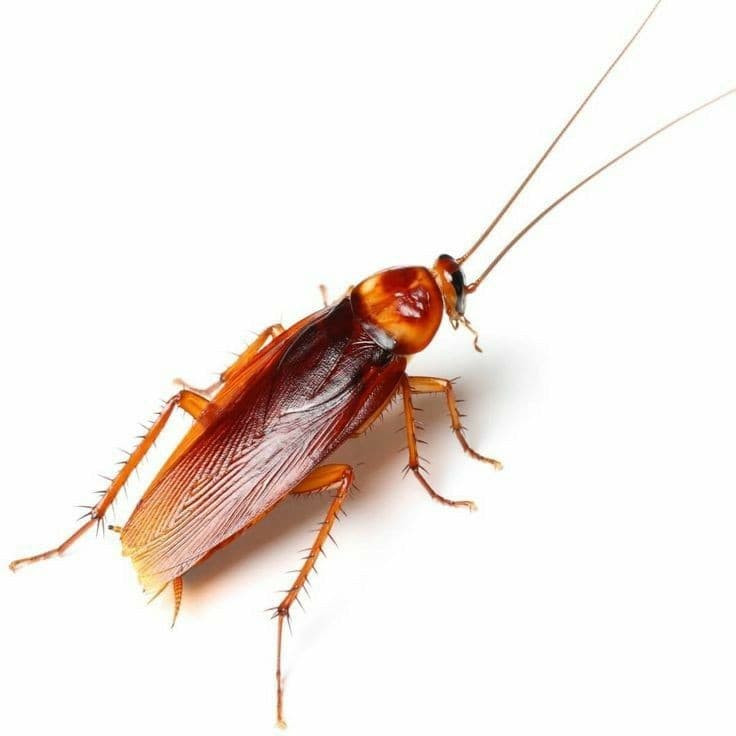
The largest, 35-40 mm, reddish-brown, with a yellowish mark on the pronotum. It lives in sewers, boiler rooms, building service chases and ducts. It glides short distances, which surprises many people. Its presence in a dwelling usually signals a connection to the sewer network or a shared boiler room, not a classic domestic infestation.
Brown-banded cockroach (Supella longipalpa)
Small like the German, but with pale bands across the wings. It likes dry warmth and settles high up: picture frames, tops of cabinets, behind televisions and electronics. It is the species missed when only the kitchen is treated.
Why treating a single unit fails
In a plex or apartment building, three routes connect units to each other, and none of them goes through a door.
- Plumbing stacks. The penetrations around sink and tub pipes are rarely sealed. It is a continuous vertical highway from the basement to the top floor.
- Floor voids and electrical chases. They cross shared walls and connect one unit to the next.
- Common areas. Laundry room, garbage room, boiler room: permanent reservoirs that reseed treated units.
Direct consequence: if your neighbour has cockroaches and is not treated at the same time as you, your treatment has an expiry date. That is not an opinion, it is mechanics.
It is also why serious building treatment starts with an inspection of adjoining units — beside, above, below — even when those occupants have reported nothing. A unit without a complaint is not a unit without cockroaches: in an early infestation, the occupant sees nothing for weeks.
Mistake number one: the aerosol spray
As with bed bugs, the consumer aerosol is the costliest move — for different reasons.
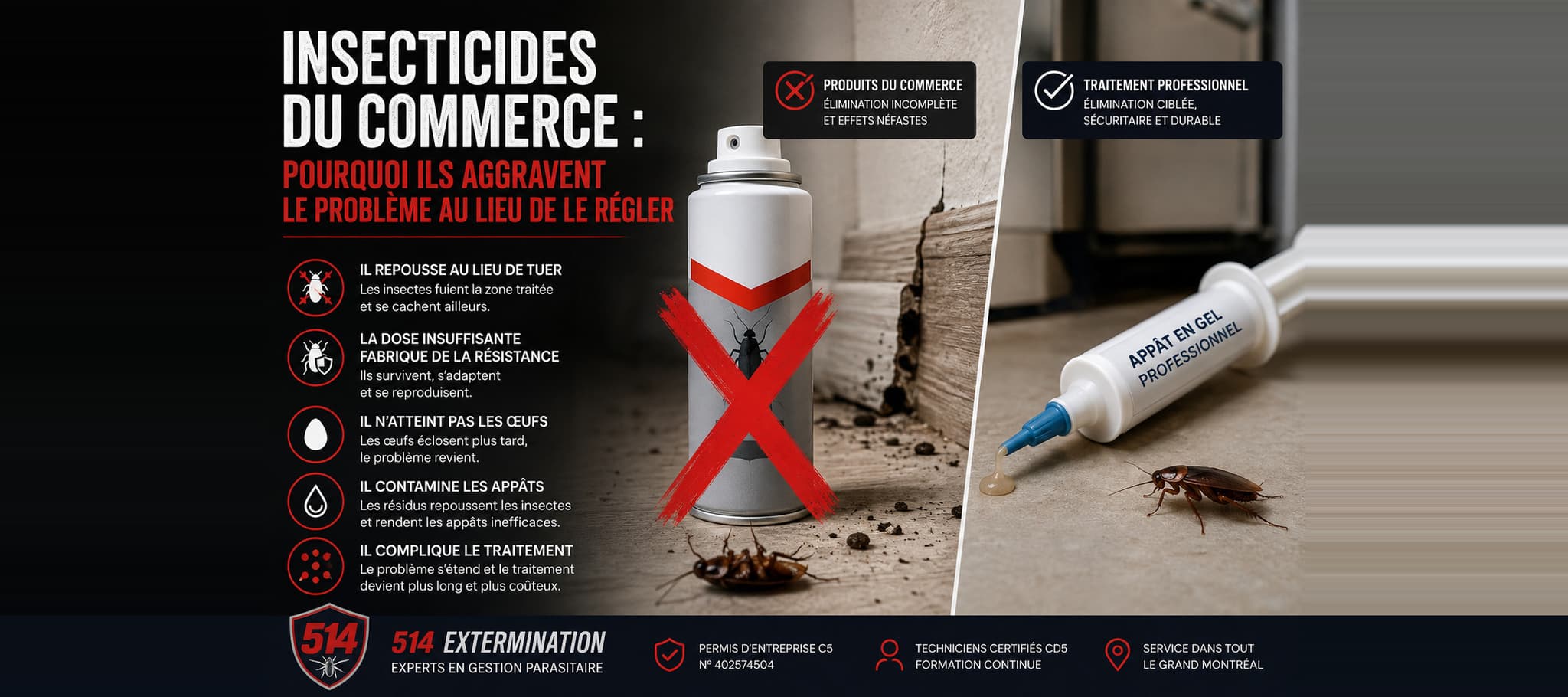
1. It repels. Cockroaches flee the treated surface and scatter into wall voids and toward neighbouring units. You turn a localised, easily treated harbourage into a population spread across several units.
2. It contaminates baits. This is the technical point almost nobody knows, and it is decisive. Gel baits work because the cockroach willingly eats them. If aerosol residue settles on or beside the bait, the insect avoids the whole zone and the bait goes inert. Spraying and then placing gel means neutralising the gel.
3. It does not reach eggs. The German cockroach's ootheca is carried by the female until hatching, and the young then emerge under cover. No surface product reaches them.
If you have already used a spray, tell the technician. It shapes the choice of bait points and the delay before the zone becomes attractive again.
Glucose aversion: why old baits stop working
Here is a documented phenomenon that explains many failures. Some German cockroach populations have developed a glucose aversion: the sugar used as an attractant in baits has become, for them, a rejection signal. They taste it and turn away.
It is an inherited behavioural adaptation, and it spreads wherever the same bait is used year after year. Concretely, that means two things:
- A bait bought at the pharmacy three years ago may be entirely ineffective against the population in your home today, without anything being "expired".
- Serious professional treatment rotates bait matrices and active ingredients rather than repeating the same product at every visit.
If someone told you "baits don't work", this is usually what they ran into — not a limitation of the method.
What actually works
1. Gel baits, placed where the insect travels
Gel is the backbone of modern treatment because it uses the insect's behaviour instead of fighting it. Cockroaches practise cannibalism and coprophagy: an individual that consumed the bait returns to the harbourage and contaminates its nestmates through droppings and its own carcass. The effect reaches individuals that never touched the product — including young that never leave cover.
Placement still matters: many small deposits in cabinet hinges, under the sink, along baseboard joints, behind and under appliances — never large blobs on open surfaces, where they dry out unconsumed.
2. An insect growth regulator (IGR)
The IGR does not kill adults: it prevents nymphs from completing their moult and sterilises part of the reproduction. That is what cuts off the next generation. Without an IGR, you lower the number of visible adults while the following generation builds up silently — hence the classic "it came back" impression.
3. Insecticidal dust in closed voids
Wall voids, outlet backs, plumbing penetrations: these are the zones neither gel nor spray reaches, and they are precisely the corridors between units.
4. The vacuum, before any product
A pass with a HEPA-filter vacuum over harbourages removes a share of the population, the oothecae and accumulated allergens in one go. It is an underrated step, and it speeds up results considerably.
The real lever: water
A cockroach survives about a month without food, but only a week without water. Water is therefore the most powerful lever you have, and the only one that depends on no product at all.
- Fix every dripping tap and every weeping trap under the sink.
- Wipe the sink and the tub floor before going to bed: activity is nocturnal.
- Do not leave plant saucers or the pet's water bowl full overnight.
- Empty and dry the drip tray under the refrigerator — a permanent water source, warm and dark: the ideal setup.
- Ventilate the bathroom; constant humidity directly favours the Oriental cockroach.
Food matters too, but less than people think: cockroaches feed on frying grease behind the stove, cardboard glue, hair and soap. "The kitchen is clean" is not protection — it is a condition that helps, nothing more.
Preparing for the visit: what changes the outcome
Preparation is not paperwork. It determines whether the technician can reach the zones that matter.
- Empty the lower kitchen and bathroom cabinets, along with the space under the sink. These are the priority bait points.
- Clear access behind and under appliances as much as possible.
- Do not bleach the surfaces right before. A freshly disinfected, damp surface repels bait; a degreasing clean a few days ahead is perfectly sufficient.
- Do not apply your own products at the same time. It is the surest way to cancel the gel's effect.
Our preparation protocol details every step, and our post-treatment guidance explains what is normal in the days that follow — notably seeing more insects for 48 to 72 hours, which is a sign the product is working, not a failure.
Your rights as a tenant in Quebec
This is the part many occupants do not know, and it is simple.
Under the Civil Code of Québec, the landlord must deliver a dwelling in good habitable condition and maintain it that way for the entire lease. A cockroach infestation falls under that obligation: treatment is the owner's responsibility, not the tenant's, and it cannot be billed to the occupant merely because they reported the problem.
A few practical markers:
- Report in writing — email or letter — and keep a dated copy. That is what counts in a dispute before the rental board.
- Document: dated photos, observation dates, rooms affected.
- Cooperate with preparation. Refused access or preparation left undone can be held against you, and it is the one point where your responsibility is genuinely engaged.
- A partial treatment is not a treatment. If adjoining units are not inspected, reinfestation is predictable — and that can be documented.
If you are a landlord or manager, the logic is the same seen from the other side: treating a single unit to save money consistently costs more by the second or third cycle. The building protocol is detailed here.
How long until it is over?
For a light to moderate infestation treated properly, a marked drop shows within 2 to 3 weeks, and elimination generally takes 6 to 8 weeks — the time needed for already-laid oothecae to hatch and for the young to encounter the bait and the growth regulator.
For a heavy or building-wide infestation, expect several spaced visits, with sticky-trap monitoring to measure the decline objectively rather than relying on sightings.
One clear signal: if you still see adults in broad daylight after four weeks, the population exceeds the capacity of its harbourages and the treated perimeter is too narrow. That is not the moment to double the dose — it is the moment to widen the inspection to neighbouring units and common areas.
Our cockroach interventions come with a written guarantee. Service and guarantee details are here, and our article on health risks explains why a case should not be left to drag, particularly with young children or an asthmatic person in the home.
Frequently Asked Questions
Why do cockroaches come back after treatment?
Do aerosol sprays work against cockroaches?
Who pays for cockroach extermination, the tenant or the landlord?
How do you tell a German cockroach from an Oriental cockroach?
How long does it take to eliminate cockroaches?
Need a professional exterminator?
Contact us for a free evaluation and a treatment plan tailored to your situation.