Fleas at Home: Why They Keep Appearing After Treatment
Seeing fleas three days after a treatment is not a failure: it is the cocoon. That stage resists insecticides and releases adults for weeks — and the entire treatment logic follows from it.
The short answer
If you still see fleas a few days after a treatment, it does not necessarily mean the treatment failed. It is almost always the cocoon.
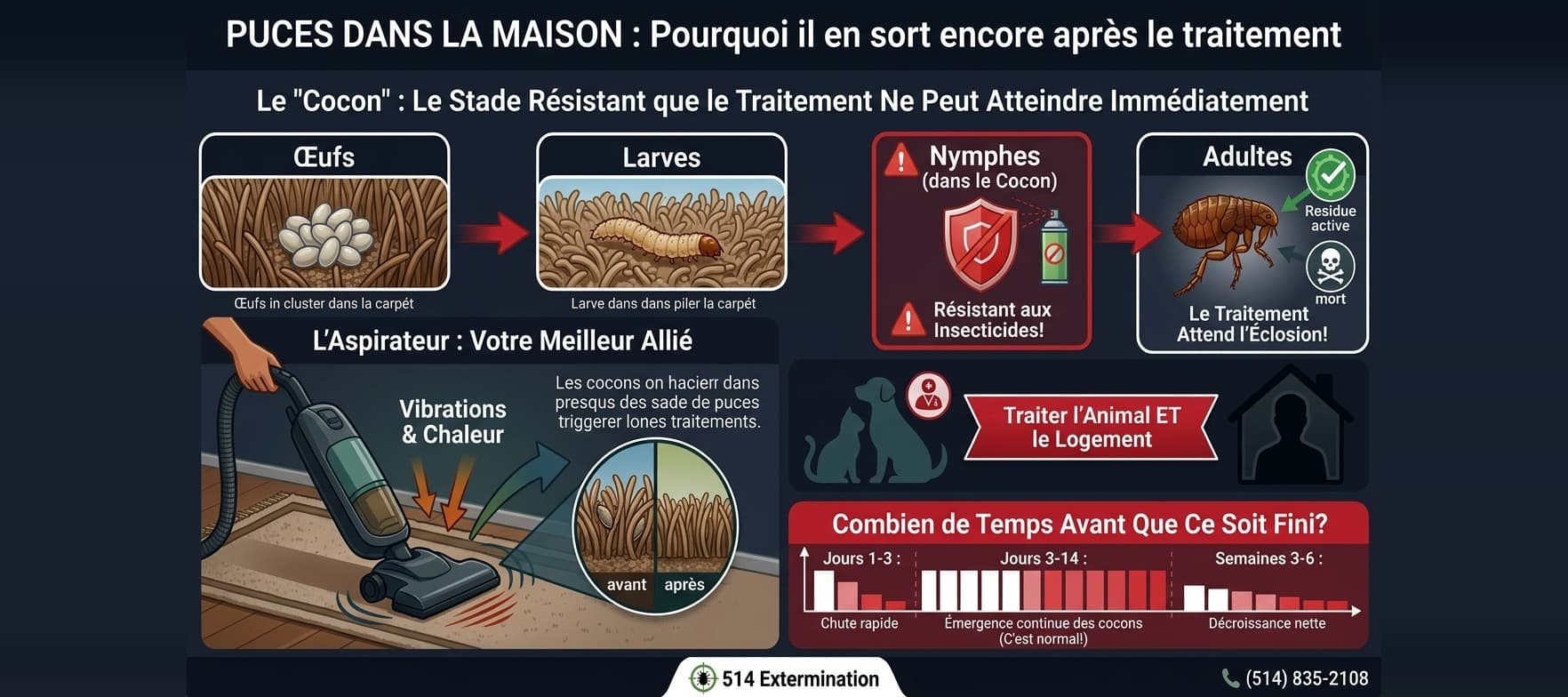
Fleas go through four stages: egg, larva, pupa enclosed in a cocoon, then adult. That cocoon is silken, sticky, and it resists insecticides far better than any other stage. A pupa can wait inside for weeks, emerging only when it detects a host: vibration, CO₂, warmth.
In other words: a treatment cannot kill what is still inside the cocoon. It kills adults, eggs and larvae, then waits for the pupae to emerge in order to reach them in turn. That is why seeing fleas after the visit is expected — and why walking through treated rooms shortens the case rather than prolonging it.
The cycle, and where the problem hides
The adults you see are the visible part of a population that mostly sits elsewhere. The commonly reported distribution gives, as an order of magnitude, roughly half as eggs, a third as larvae, a small fraction as pupae and only a few percent as adults. The exact proportion varies with the stage of the infestation, but the lesson holds: what you crush on the animal is almost nothing.
The egg does not stay on the animal
The female lays on the host, but the eggs are smooth and fall into the environment: carpet, between floorboards, the dog's bed, the sofa, the bed. The infestation is therefore not on your pet, it is in your home. That is the first reason treating the animal alone fails.
The larva avoids light
Larvae hatch and burrow toward the base of carpets, under furniture, into floor cracks — where a vacuum reaches poorly and a surface spray never arrives. They feed notably on adult droppings, rich in digested blood.
The pupa is untouchable
This is the stage that governs everything. Once spun, the cocoon shields the pupa from insecticides, and its sticky surface coats it with dust and fibres, anchoring it in the carpet. It can wait a long time. This explains something many people report without understanding it: a home left empty for months where the new occupant is bitten on day one. The cocoons were there, waiting for a signal.
Why you must treat the pet AND the home
This is the most common mistake, and it is made in both directions.
Treating only the animal — through your veterinarian or a suitable product — removes the fleas climbing onto it, but leaves in the home the eggs already fallen, the larvae and the cocoons. The animal is bitten continuously as adults emerge.
Treating only the home leaves on the animal a living reservoir that starts laying again the next day.
The two parts are inseparable, and they are not the same people's job: the animal is your veterinarian's, who will choose a product suited to its species, weight and age. We do not treat animals and recommend no veterinary product — that is their call. One warning is worth stating: several domestic insecticides contain permethrin, to which cats are especially sensitive. Never transfer a product intended for a dog onto a cat.
What a professional treatment does — and does not do
What it does. An adulticide combined with a growth regulator applied to the surfaces where larvae develop: room perimeters, under furniture, along baseboards, the pet's resting areas, carpets and rugs. The regulator prevents larvae from reaching adulthood — that is what breaks the cycle rather than counting the dead.
What it does not do. It does not sterilise the cocoons. No registered product does so reliably. The strategy is therefore to leave an active residue where emerging adults will land, so that they die as the cocoon opens, not before.
This is exactly why activity observed after treatment is not a failure. It is expected: every adult that emerges is one cocoon fewer.
The vacuum: your best tool, for a surprising reason
Vacuuming does more than remove eggs and larvae — useful as that is. Its main effect lies elsewhere: vibration and warmth trigger the cocoons to hatch.
It is counterintuitive, but it is what you want. Bringing the pupae out faster exposes them to the active residue and shortens the emergence period instead of stretching it. Concretely, after a treatment:
- Vacuum daily for two to three weeks, focusing on room perimeters, under furniture and the pet's resting areas.
- Empty the bag or canister outside immediately, in a sealed bag.
- Keep moving through the treated rooms normally. An abandoned home prolongs the case, because nothing signals a host to the pupae.
- Wash bedding and the pet's bed in hot water, and dry on the hottest setting.
One caveat: do not wash treated surfaces for the period stated in the guidance. The residue must stay in place to intercept what emerges. The full post-treatment guidance is published here, and the preparation to do before the visit is detailed here.
How long until it is over
The cycle sets the timetable, and you need to know it so as not to conclude too early.
- Days 1 to 3: rapid drop in the adults present.
- Days 3 to 14: continuous emergence from cocoons. This is when fleas are still seen, and it is normal.
- Weeks 3 to 6: activity declines markedly as the cocoon stock is exhausted and the growth regulator prevents the next generation.
Two markers for what follows. Declining residual activity during the first two weeks is expected. But activity that is stable or increasing after three weeks indicates something else: an untreated animal reseeding, an outdoor access bringing stray animals, or an untreated zone — a basement, a crawl space, a garage.
Fleas without a pet: not a contradiction
This is a frequent and puzzling situation. Three explanations, in order of frequency:
- A previous occupant had a pet. The cocoons were waiting, and your arrival — vibration, warmth, CO₂ — triggered them. It is the classic July 1st scenario in Montreal.
- A wild animal nested in the structure: a squirrel in the attic, a raccoon under the porch, a skunk under the shed. Once the animal leaves, its fleas seek a new host indoors. In that case, treating without fixing the access does not hold — physical exclusion is part of the file.
- A neighbouring unit is infested, in a plex.
The distinction is not academic: it changes what must be treated. It is also one reason the on-site inspection is billed — it is a diagnostic act, and its cost is deducted from the price of the intervention if the work is entrusted to us.
What does not work
- Foggers. The mist settles on surfaces and penetrates neither the base of carpets nor under furniture, which is exactly where larvae live. Its propellant is also flammable. We detail here why these products make cases worse.
- A flea collar alone. It acts on the animal, not on the 95% of the population that is in the home.
- Salt, baking soda, piles of diatomaceous earth. Marginal, slow, and with no action on cocoons.
- Leaving the home for a few weeks. The pupae wait. You return to the same point, with an intact stock of cocoons ready to hatch on your arrival.
- Throwing out the carpets expecting that to settle it. Cocoons are also in floor cracks, under baseboards and in upholstered furniture.
Flea bites: recognising them
Flea bites are reasonably distinguishable from bed bug bites, and the confusion is common:
- Location: mainly ankles and lower legs, because the flea jumps from the floor. Bed bugs bite areas exposed during sleep — arms, shoulders, neck.
- Appearance: a small red papule with a darker central point, often in small irregular groups.
- Timing: at any time of day, whereas bed bugs feed mainly at night.
Fleas can bite humans, but they do not live on them: they find neither the fur nor the conditions they need. Another reason to treat seriously: fleas can transmit the tapeworm Dipylidium caninum to an animal — or a young child — that ingests one. If in doubt, your veterinarian or doctor is the right contact.
What to do now
- Have your veterinarian treat the animal, in parallel with the home. Both parts must advance together, or each cancels the other.
- Vacuum and hot-wash bedding before the visit, then daily for two to three weeks afterwards.
- Spray nothing yourself. Repellent residues complicate professional treatment and do not reach the cocoons.
- Prepare the home to protocol — it is published here, and it is what makes the larval zones reachable.
- Expect to see fleas for two weeks. It is the sign that cocoons are opening and meeting the product.
Our treatments are covered by a written guarantee. The price estimate is free; the on-site inspection is billed and deducted from the price of the intervention. Phone: (514) 835-2108.
Frequently Asked Questions
Why do I still see fleas after the treatment?
How long does it take to get rid of fleas?
Must the pet be treated at the same time as the house?
Can you have fleas without owning a pet?
Should you leave the house after a flea treatment?
How do you tell flea bites from bed bug bites?
Need a professional exterminator?
Contact us for a free evaluation and a treatment plan tailored to your situation.