The Cockroach Life Cycle: Why Their Biology Makes DIY Extermination a Losing Game
You are not losing to an insect, you are losing to a calendar. Each stage of the German cockroach life cycle neutralises a different method — and the tool that breaks the cycle is not sold to the public.
You are not losing to an insect, you are losing to a calendar
Most people approach a cockroach infestation as a product problem: find the one that kills. That is the wrong framing. The product is not the limiting factor — the development cycle is.
The German cockroach (Blattella germanica), the species occupying nearly every infested Montreal home, has a biology that methodically neutralises each method available to the public. Not by accident: it is the result of decades of selection under insecticide pressure.
This article walks through each stage of the cycle, and what each one makes impossible.
What you see, and what actually exists
First gap to grasp: the visible individuals are a small minority of the population.
Cockroaches are thigmotactic — a word describing a very concrete need: they seek simultaneous contact with several surfaces on their body. A crack where back and belly touch at once reassures them; open space stresses them. So they spend most of their lives packed into gaps a few millimetres wide: cabinet hinges, the fridge motor, under the dishwasher, baseboard joints, wall voids.
Two practical consequences:
- Seeing a cockroach in broad daylight is not an incident. It is a density signal: the population exceeds the available harbourage and is spilling out.
- Treating what is visible touches almost nothing. You act on the surface while the underlying population stays intact.
The cycle, stage by stage
The ootheca: a capsule the female carries
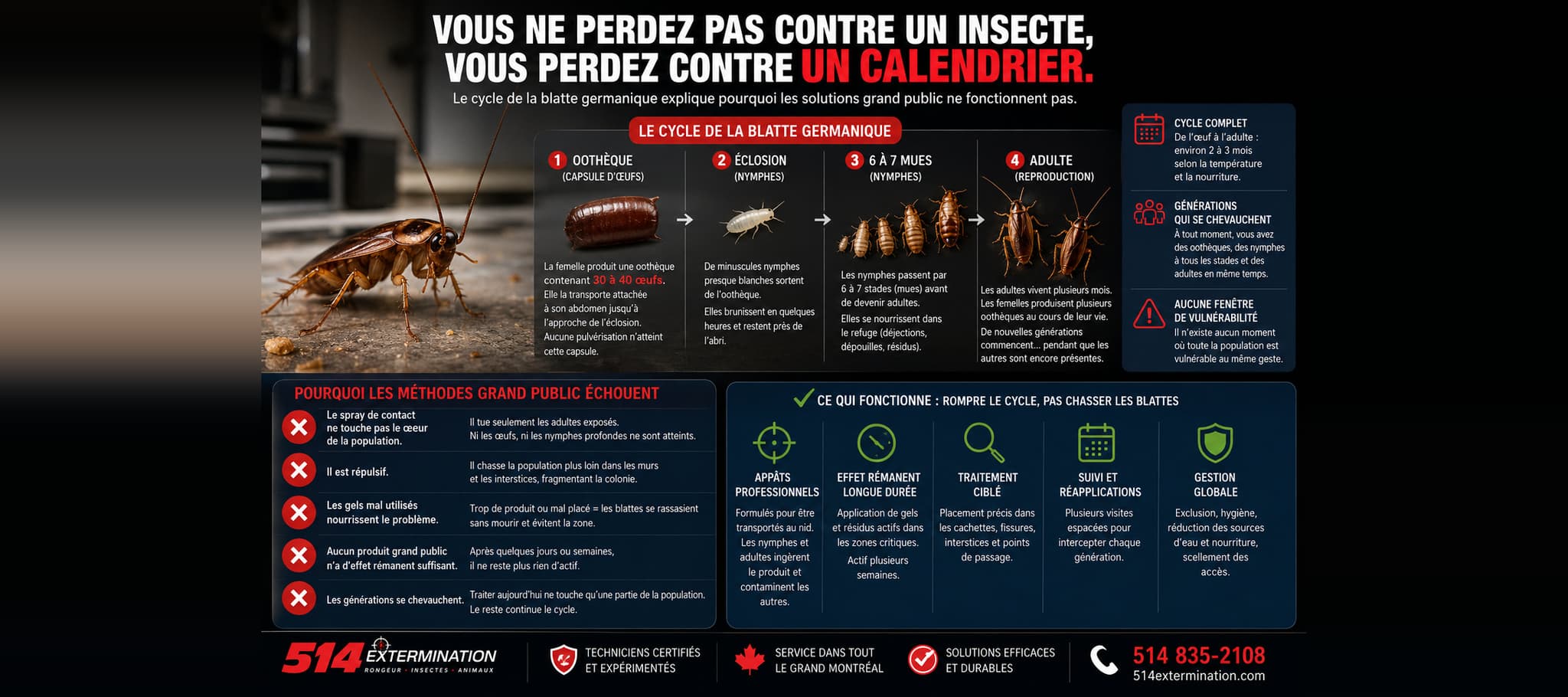
The female does not lay individual eggs. She produces an ootheca: a rigid brown capsule holding roughly 30 to 40 eggs.
And here is the point that changes everything: in the German cockroach, the female carries that capsule attached to her abdomen until hatching approaches. She only deposits it shortly before, in a sheltered crack.
In other words, the next generation is both shielded by a shell and mobile. It travels with the mother, into harbourages no surface spray reaches. No consumer contact insecticide gets to it. A female produces several successive oothecae over her life.
Six to seven moults before adulthood
Hatching releases tiny, nearly white nymphs that darken within hours. They must pass through six to seven stages, each separated by a moult, before becoming adults capable of reproducing.
These nymphs do not behave like adults. They stay much closer to harbourage, venture out less, and feed partly on adult droppings and shed skins. That is good news for bait treatment — the product circulates inside the refuge — and very bad news for a spray, which never reaches that fraction of the population.
Overlapping generations
From egg to adult, expect on the order of two to three months depending on temperature and available food. In a kitchen heated year-round, the cycle never really slows.
Above all: the generations are not synchronised. At any given moment your home contains simultaneously oothecae, nymphs at every stage, and adults. So there is no window in which the whole population is vulnerable to the same action. That is the core of the problem, and no hardware-store product can work around it.
The arithmetic behind the speed
Take a single female. Several successive oothecae of 30 to 40 eggs each, offspring that become breeders themselves within two to three months, and so on.
The theoretical projections that circulate — tens of thousands of individuals in a year — assume total survival and unlimited food. They never occur in practice, and it would be dishonest to present them as an observation. But they give the right order of magnitude for what actually matters:
Each week of delay does not cost slightly more. It costs an extra fraction of a generation, and the effect is multiplicative, not additive. That is why an infestation that seems stable for a month can appear to explode in two weeks: you are not seeing the acceleration, you are seeing the moment the harbourages overflow.
What each stage makes impossible
Method by method, against the cycle:
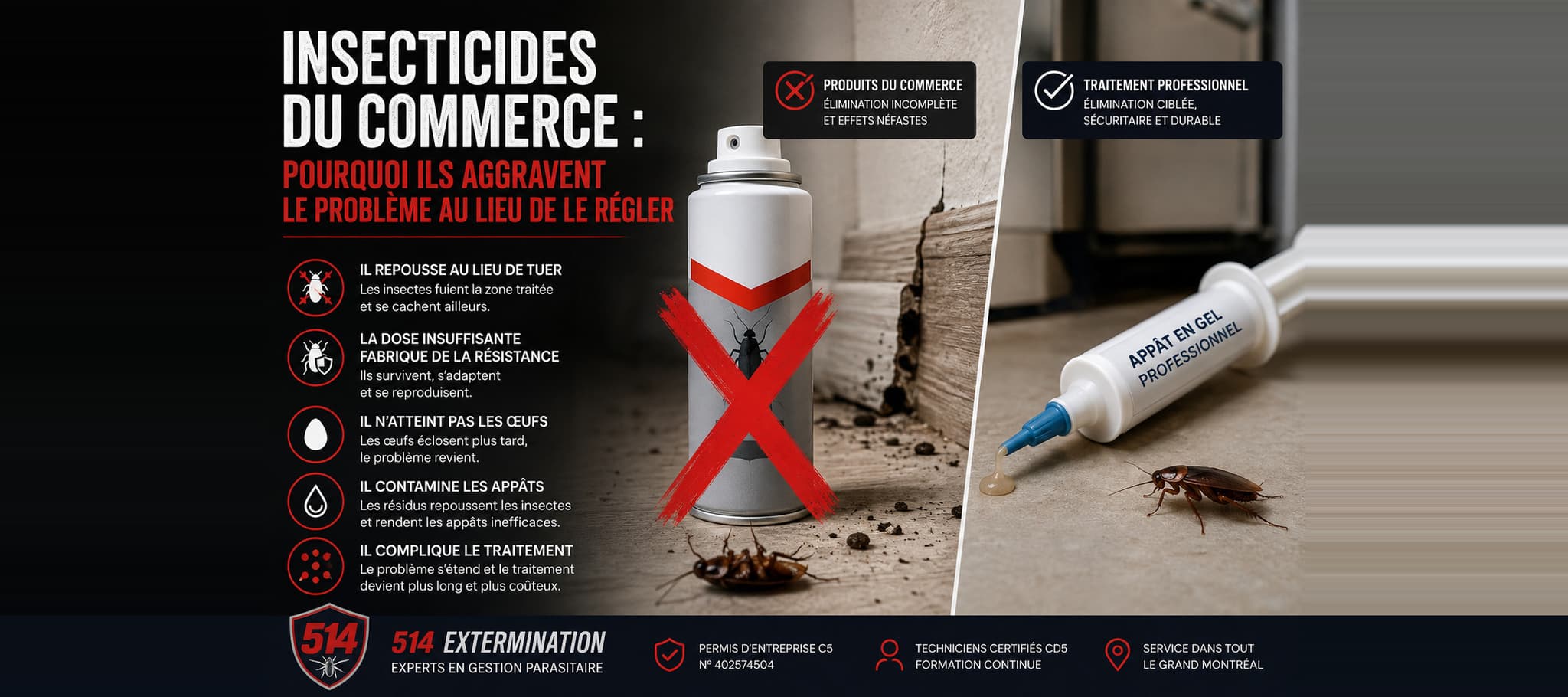
- Contact spray reaches neither the eggs nor the deep nymphs. It kills a share of exposed adults — precisely the most replaceable fraction of the population.
- It repels, so it fragments the harbourage. A colony concentrated in two hiding places becomes one spread across ten, including wall voids leading to the neighbour. You have not reduced the population, you have scattered it — and made it harder to reach.
- Its residues neutralise baits. Gel placed on an aerosol-treated surface is avoided. You disable in advance the one tool that would have worked, including the one a professional places after you.
- Foggers do not penetrate cracks, which is exactly where the population lives. They deposit product everywhere except on the target.
- Waiting does not work. Unlike a seasonal infestation, nothing halts the cycle in a heated home.
We break down here, product by product, what store-bought insecticides actually do in your home, including their risks to children and pets.
The tool that breaks the cycle is not for sale
Here is the most concrete — and most verifiable — reason an occupant cannot win alone.
To break a cycle with overlapping generations, you must act on development, not only on the individuals present. That is the role of insect growth regulators (IGRs): they prevent nymphs from completing their moult and sterilise part of the reproduction. They do not kill a visible adult — they remove the next generation, which is the real engine of the infestation.
In Quebec, products in that category, like professional gel baits, belong to the restricted pesticide classes: buying and applying them requires a business permit and an applicator certificate issued by the Ministry of the Environment. This is not about price or trade secrets. They are not sold to the public, full stop.
You can therefore buy an entire hardware aisle and still never hold the tool that acts on the cycle. That is precisely why "impossible without a professional" is not a sales line but a regulatory consequence.
What professional treatment does to the cycle
A serious treatment does not try to kill everyone on the day. It attacks the cycle on three fronts at once:
- Adults and mobile nymphs, through gel baits placed where the insect actually travels — cabinet hinges, under the sink, baseboard joints, behind and under appliances. Since cockroaches practise cannibalism and coprophagy, the bait spreads inside the refuge and reaches individuals that never touched the product.
- The next generation, through a growth regulator, so that nymphs from already-laid oothecae never reach adulthood.
- The closed corridors, through insecticidal dust in wall voids, behind outlets and at plumbing penetrations — the passages between units.
To which is added what no product provides: identifying the species, locating the harbourages, rotating active ingredients so as not to select for resistance, and widening the perimeter to adjoining units when the source is elsewhere. We explain here why treating a single unit in a building almost always fails.
What you can do, and what actually counts
Your role is not nil — it simply lies elsewhere than in applying products. Three actions have a real effect on the cycle:
- Cut off the water. A cockroach survives about a month without food, but only a week without water. Fix leaks, wipe the sink and tub floor before bed, empty the tray under the fridge, do not leave the pet's bowl full overnight. It is the most powerful lever you have, and it depends on no product.
- Vacuum the harbourages, with a HEPA filter. You remove adults, nymphs, oothecae and accumulated allergens in one pass. Take the bag outside immediately.
- Spray nothing. The most counterintuitive and most useful action: every day without aerosol is a simpler, shorter and cheaper case to treat.
And prepare the home to protocol before the visit: every step is detailed here. Good preparation is what makes the zones that matter reachable.
How long before the cycle ends
Biology also sets the timetable for getting out, and it explains why patience is part of the treatment.
Oothecae already laid on the day of the intervention will hatch: no product prevents that. So for a light to moderate infestation treated properly, expect a marked drop within 2 to 3 weeks, then elimination generally taking 6 to 8 weeks — the time for those hatchlings to meet the bait and the growth regulator.
Two markers for reading what follows:
- Seeing more insects during the first 48 to 72 hours is normal. The product flushes them out of harbourage. It is a sign it is working, not a failure.
- Still seeing adults in broad daylight after four weeks is not. That indicates the treated perimeter is too narrow, and must widen to neighbouring units and common areas.
Our post-treatment guidance states what is normal day by day.
When to call
The cycle works against you from the first individual. Call as soon as you notice any of these signs: droppings as small black specks resembling coffee grounds in cabinets or behind appliances, translucent shed skins near cracks, a musty, oily odour, or a cockroach in broad daylight.
That last sign is the most misread: it does not signal a lone intruder, but a population spilling out of its hiding places.
Inspection and quote are free, the price is firm before the work, and our cockroach treatments come with a written guarantee. Request an inspection here, or call us at (514) 835-2108.
Frequently Asked Questions
How many eggs does a German cockroach ootheca contain?
How long does it take a cockroach to reach adulthood?
Why don't store-bought insecticides kill cockroach eggs?
What is a growth regulator and why isn't it sold in stores?
Is seeing a single cockroach serious?
Can you get rid of a cockroach infestation on your own?
Need a professional exterminator?
Contact us for a free evaluation and a treatment plan tailored to your situation.