Pest Control in Restaurants: How a Treatment Actually Works in a Commercial Kitchen
A restaurant is not treated like an apartment: the work happens overnight, the kitchen is not sprayed, and the staff on site often decide whether the treatment holds. Here is how it goes, from the first call to the follow-up.
In brief
In food service, pest control is done outside business hours, with products placed inside cavities (motor housings, rails, joints, wall voids) rather than sprayed on work surfaces. It runs in four stages: an inspection that locates the harbourages, preparation of the kitchen by the staff, the treatment itself, then a follow-up. The point restaurant owners underestimate most: what happens between visits — cleaning, handling cardboard, keeping doors shut — matters as much as the product. For the regulatory framework (what the inspector requires and what a conviction costs), see our article on restaurants and food inspection.
Why a restaurant is not treated like an apartment
Three constraints change everything:
- You cannot close. An apartment can be vacated for a few hours; a restaurant loses an evening's revenue. The work has to fit between closing time and the morning crew's arrival.
- Nothing can be contaminated. Every product is chosen and placed so it never touches food, a prep surface or a utensil. That is why spraying the room is almost always ruled out.
- Pests come back through the front door. Daily deliveries, doors open during service, shared walls: a restaurant is re-exposed constantly. The goal is not only to eliminate, but to maintain.
Step 1 — The inspection
Before treating, you need to know what and where. The technician walks the kitchen with a flashlight, starting with the spots nobody cleans nightly:
- under and behind heavy equipment (fryers, refrigerators, dishwashers);
- motor housings and compressors, permanently warm;
- rails and hollow legs of stainless tables;
- floor drains and traps;
- the stockroom, receiving area and waste room;
- staff lockers and the break room.
The goal is to identify the species — German cockroaches are not treated like Oriental cockroaches, mice not like rats, drain flies not like house flies — and to find the harbourages, not just the visible insects. See our guide to identifying cockroach species.
The inspection ends with a written plan: areas to treat, chosen method, required preparation, exclusion defects to fix.
Step 2 — Preparing the kitchen
This is the step that most often makes the difference, and it falls to the restaurant team. The technician provides the exact list for the treatment; here is what is usually asked:
- Put away all exposed food in closed containers or the refrigerator.
- Cover or put away dishes and utensils left on open shelving.
- Degrease under and behind equipment. Built-up grease is competing food: a cockroach with all the grease it wants eats less bait.
- Clear access to walls, baseboards and under wheeled equipment.
- Empty and remove cardboard from the stockroom. Corrugated cardboard is both a shelter and a vehicle for cockroaches.
- Spray nothing in the days before (see below).
Our treatment preparation page details these instructions.
Step 3 — The treatment
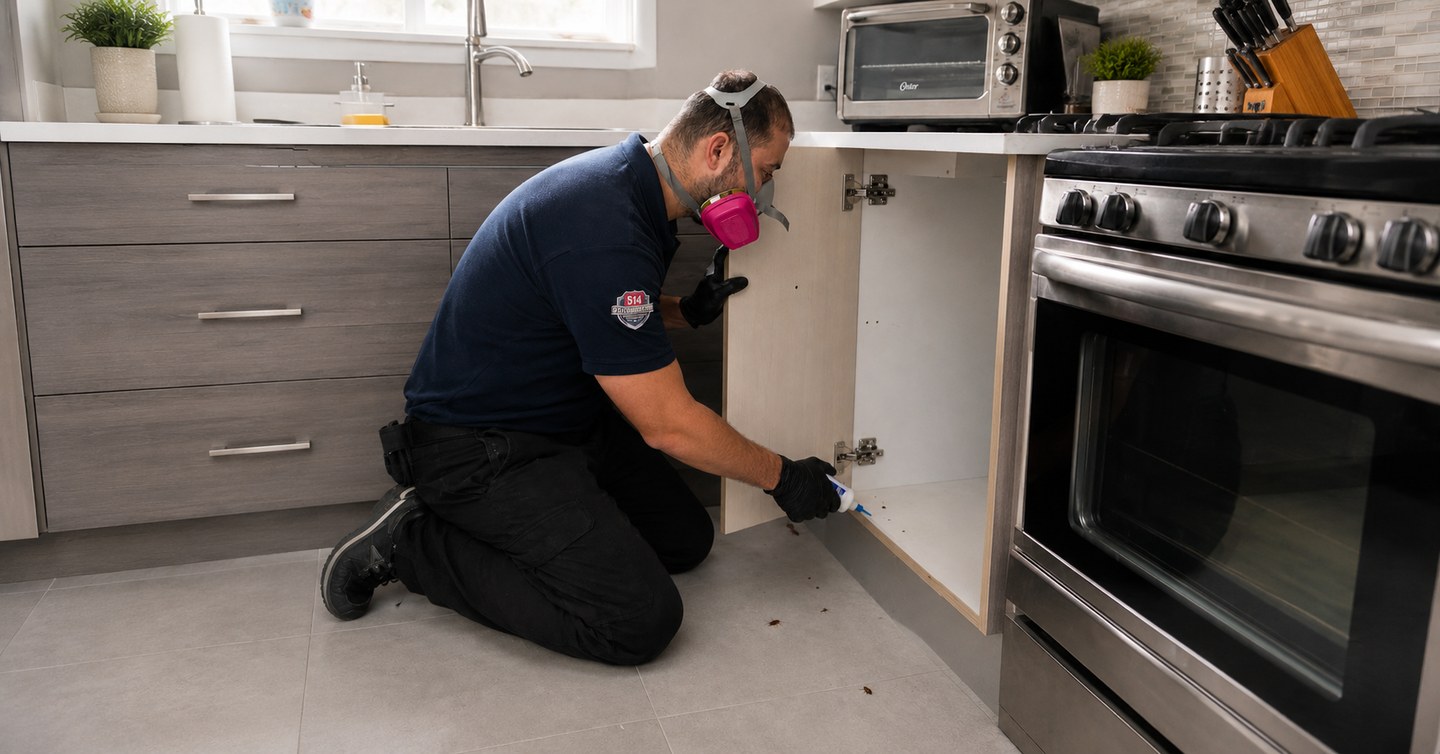
It takes place overnight or early in the morning, with the kitchen closed. Depending on the pest, it combines several tools:
Against cockroaches
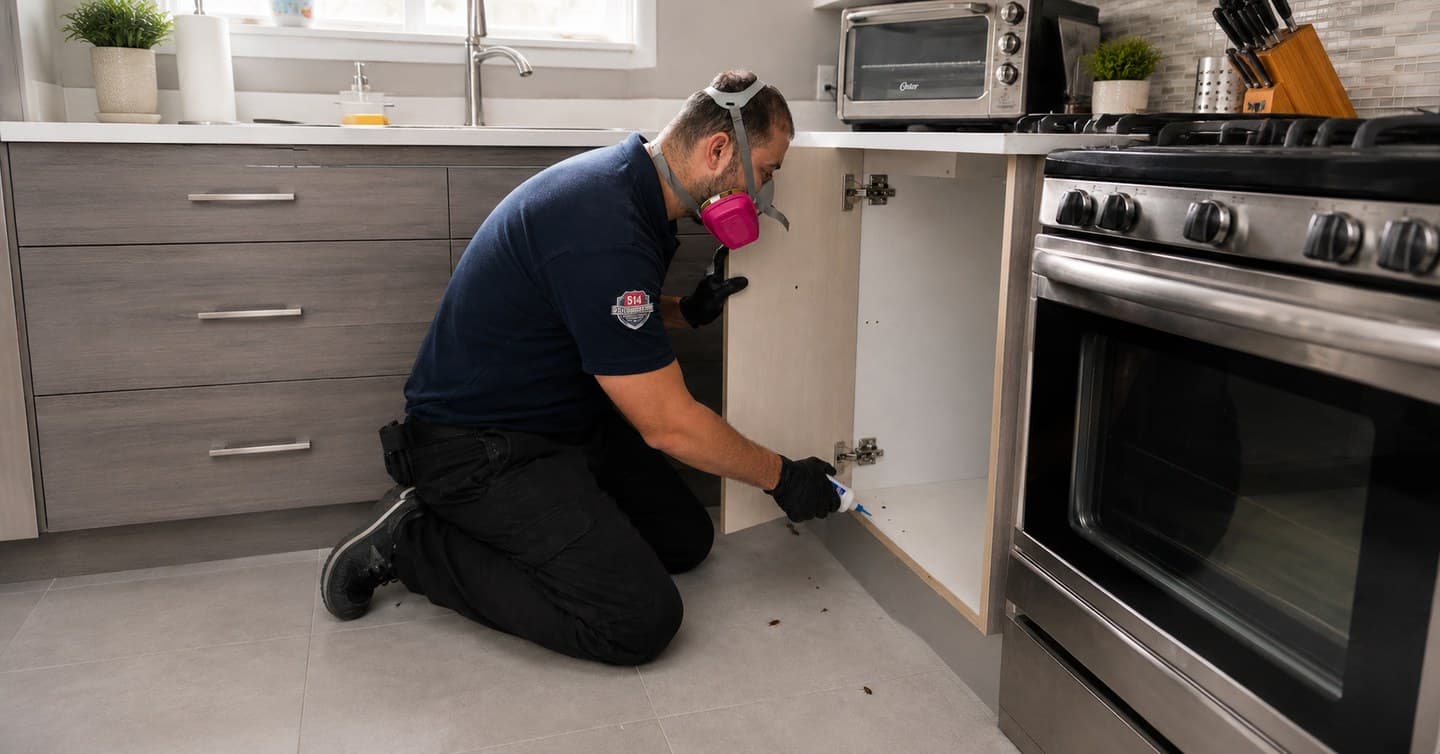
- Gel bait in small dots in cracks, hinges, motor housings and rails. Cockroaches eat it and carry it back to the harbourage, where it also reaches those that never come out.
- Insect growth regulator (IGR), which keeps nymphs from reaching adulthood and reproducing. It deals with the generation that will hatch from oothecae already laid.
- Dust in voids — wall voids, pipe chases, under closed counters — where no food can be reached.
Against mice
- Mechanical traps indoors, numbered and placed along walls, on travel routes.
- Locked bait stations, kept to places where they pose no risk to food, most often outdoors or in technical areas.
- Sealing the entry points found: pipe penetrations, door bottoms, vent openings. See mouse entry points.
Against drain flies
No insecticide in the room: the source is treated — the biofilm in drains and traps — by mechanical cleaning and a suitable product.
Step 4 — The next morning and the weeks after
- Re-entry delay. It depends on the product and the room treated. The technician states it on site and records it in the report; with gels placed in cavities, it is usually compatible with opening the next day.
- Clean surfaces, not cavities. Wash work surfaces and floors as usual. Do not hose or degrease the inside of the cracks and housings where gel was placed.
- Seeing more cockroaches for a few days is normal. The treatment flushes and weakens them; they come out into the open. That is a sign the product is working, not failing.
- Remove the traces. Droppings, shed skins and dead insects should be cleaned up as you go: at inspection, they count as presence.
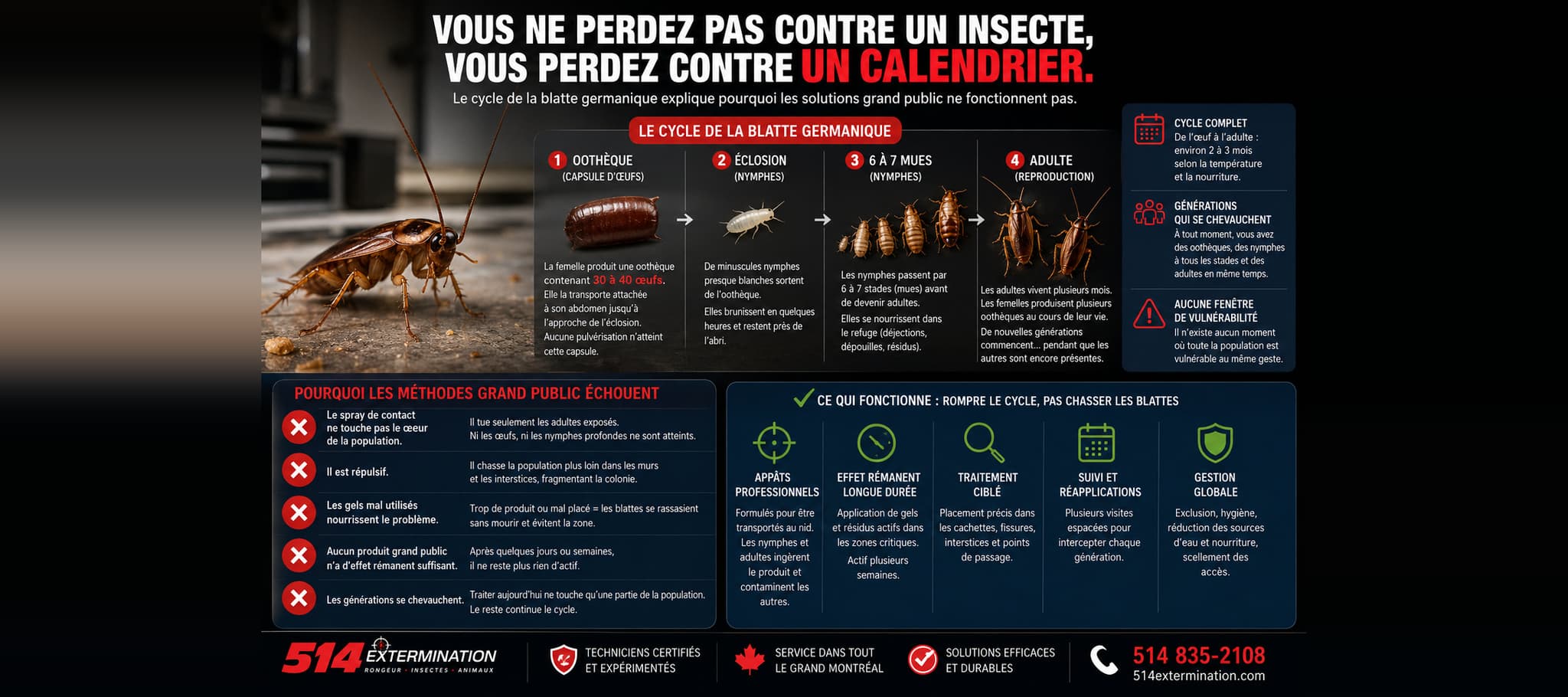
- Follow-up visit. For cockroaches it is scheduled because the oothecae present on treatment day hatch afterwards. Our article on the cockroach life cycle explains why.
The mistakes that undo a treatment
They are almost always the same, and almost always in good faith:
- Spraying a store-bought insecticide over the gel. The spray contaminates the bait, cockroaches avoid it, and they scatter to other rooms. See why to avoid consumer insecticides.
- Setting off a bug bomb. It does not reach the cavities where cockroaches live and leaves residue on every surface in the kitchen.
- Degreasing the cavities the day after treatment, which strips the gel.
- Keeping delivery boxes in the stockroom "because it's handy."
- Moving or throwing out mouse traps without saying so. A numbered trap that disappears is data that disappears.
- Leaving the delivery door open through the whole receiving window in summer.
The staff's role between visits
The technician spends a few hours a month in your kitchen. Your team spends all the others there. A few habits are enough to change the outcome:
- A designated contact who receives the reports and liaises with the exterminator.
- A sightings log within reach: date, location, what was seen. "Two cockroaches under the dishwasher on Tuesday" is valuable information for the next visit.
- A quick look at boxes at receiving, before they go into the stockroom.
- Drains and under-equipment areas on the weekly cleaning schedule.
- Garbage taken out every night, lids closed.
How often?
No frequency is set by law: the standard requires a result — premises free of pests and their droppings. Frequency is therefore set by risk: kitchen volume, basement, history, neighbours, type of deliveries. A high-volume kitchen often starts with monthly visits, then the frequency is adjusted based on what the traps and the log show. A shop selling only packaged goods does not have the same needs.
How we work in restaurants
- Outside business hours — early morning, evening or overnight, depending on your operation.
- Targeted applications into cavities, never onto work surfaces.
- CD5 certified technicians and Health Canada registered products. Business licence C5 no. 402574504.
- A written report at every visit — findings, products used, recommended corrections — for your logbook.
- Follow-up visit on cockroach treatments.
One limit we state up front: if an exclusion defect is not fixed (a door that does not close, a shared wall with an infested business), treatment compensates without resolving. We write that in the report. The terms of our guarantee are published.
The first exchange is a free price estimate. The detailed inspection is billed, then deducted from the price of the treatment if you go ahead. See also our commercial pest control page.
For a restaurant in Montreal, Laval, the South Shore or the North Shore, call us at (514) 835-2108.
Frequently Asked Questions
Does the restaurant have to close during treatment?
How should the kitchen be prepared before the exterminator comes?
Why are there more cockroaches after treatment?
How often should a restaurant have an exterminator come?
Can bug bombs be used in a commercial kitchen?
Need a professional exterminator?
Contact us for a free evaluation and a treatment plan tailored to your situation.