Restaurants and Food Businesses: What the Inspector Looks For, and What a Pest Really Costs
In a home, a few cockroaches are a nuisance. In a food establishment, they are a documented non-compliance — and the conviction that can follow stays public far longer than the fine hurts.
In brief
In Quebec, the Food Regulation (RLRQ, chapter P-29, r. 1) requires at section 2.1.2 that the premises be « exempt de contaminants, de polluants, de toute espèce d'animaux y compris les insectes et les rongeurs ou de leurs excréments » — free of contaminants, pollutants, any species of animal including insects and rodents, or their droppings. There is no tolerated threshold, and droppings count as much as a live insect. In Montreal, MAPAQ does not inspect directly: the City of Montreal's Food Inspection Division does, acting as the ministry's agent. A conviction under the Food Products Act is published — MAPAQ posts the last 24 months with a search tool, and the City of Montreal publishes an open dataset going back to January 2011 with the establishment name, address, description of the offence and the fine amount. 514 Extermination serves commercial clients across Greater Montreal, outside business hours, with a logbook and a written report at every visit.
What separates commercial from residential is not the pest
It is the consequence.
In a home, finding two cockroaches behind the dishwasher is unpleasant and gets fixed. In a restaurant, the same observation made by an inspector becomes a non-compliance entered in the report, which can lead to a statement of offence, then a judgment, then an entry in a public list anyone can consult — a customer, a competitor, a journalist, a franchisor, an insurer.
The pest is the same. The exposure is not. That is why a commercial program is not simply a residential treatment repeated: it is built to produce evidence as much as a result.
In Montreal, it is not MAPAQ at the door
One confusion comes up constantly with restaurant operators, and it has practical consequences.
Elsewhere in Quebec, food establishments are inspected by the Ministère de l'Agriculture, des Pêcheries et de l'Alimentation (MAPAQ). Within the Montreal agglomeration, inspection is carried out by the City of Montreal's Food Inspection Division, acting as MAPAQ's agent under an agreement.
This does not change the standard — the same provincial regulation applies — but it changes three concrete things:
- The inspector at your door is a City employee, not a ministry employee.
- The scope is broad: restaurants, grocers, bakeries, butchers, caterers, school and healthcare cafeterias, kiosks, festivals, street-food preparation, food warehouses.
- Montreal convictions are published both by MAPAQ and by the City, in its open data portal.
The real standard: no threshold
Here is the reference text, at section 2.1.2 of the Food Regulation:
« Le lieu ou le véhicule doit être exempt de contaminants, de polluants, de toute espèce d'animaux y compris les insectes et les rongeurs ou de leurs excréments. »
Three elements deserve a second reading.
"Exempt" — free of. Not "reasonably controlled," not "below a threshold." There is no acceptable number of cockroaches in a commercial kitchen.
"Any species of animal." The provision is not limited to classic pests. The regulation explicitly carves out the service dog accompanying a person in the public service area — which tells you how broad the default rule is.
"Or their droppings." This is the phrase almost nobody reads, and the one that catches the most operators. You can be non-compliant without a single live insect on site. Mouse droppings behind a refrigerator, cockroach specks in a drawer slide, shed skins in a dropped ceiling: the treatment may have worked, but the cleanup did not follow, and what remains is documentable.
The operational lesson is blunt: after a treatment, removing the traces is part of the job, not an optional finishing touch.
The section almost nobody cites
The same regulation goes beyond the absence of pests. At section 2.1.5, on the condition of rooms used to prepare products, the third paragraph reads:
« les portes, fenêtres, moustiquaires et bouches d'aération doivent être ajustées de façon à empêcher l'entrée de toute espèce d'animaux y compris les insectes et rongeurs. »
Doors, windows, screens and air vents must be fitted so as to prevent the entry of any species of animal, insects and rodents included. In other words, the regulation does not only require a result: it requires a means, and that means is physical exclusion.
The implication is wider than it looks. A service door with daylight showing under it is a shortfall in itself, even on a day when no pest is present in the building. An unscreened air vent, a warped window frame, a hood-exhaust flap stuck open: each is a fitting defect within the meaning of the regulation.
It is also why a purely chemical approach plateaus in commercial settings. You can treat a back kitchen every month while its delivery door sits ajar all summer — you will only be treating the next arrivals. On this, see our article on mouse entry points, whose principles apply directly to a commercial building.
The real cost is not the fine
When a shortfall leads to a conviction under the Food Products Act, the fine is the shortest part of the story.
MAPAQ publishes convictions of food establishments for the last 24 months, with a search tool open to everyone.
The City of Montreal goes further. Its open data portal publishes the list of agglomeration establishments convicted under that Act. The dataset is updated monthly and goes back to January 2011. For each file it contains: the establishment name, the operator's name, the address, the offence date, the judgment date, the description of the offence and the fine amount.
Three consequences operators underestimate:
- It is effectively permanent. MAPAQ drops files after 24 months; the City's open data keeps the history since 2011.
- It is machine-readable. A structured dataset gets pulled, republished and indexed well beyond its source. Media outlets draw monthly articles from it, naming the sanctioned establishments.
- It outlives the owner. The entry stays attached to the establishment name and its address.
We deliberately quote no fine amounts here: they vary from one judgment to the next with the nature and repetition of the shortfalls. They appear in the public list, case by case — that is the source to consult, not an invented average.
The three pests that fail an inspection
The German cockroach
By far the leading cause. It seeks warmth and moisture, which a commercial kitchen supplies around the clock. It does not live in the open: it settles in the motor housings of refrigerators and dishwashers, equipment mounting rails, drawer slides, the inside of hollow stainless legs, and gaps behind loose tiling.
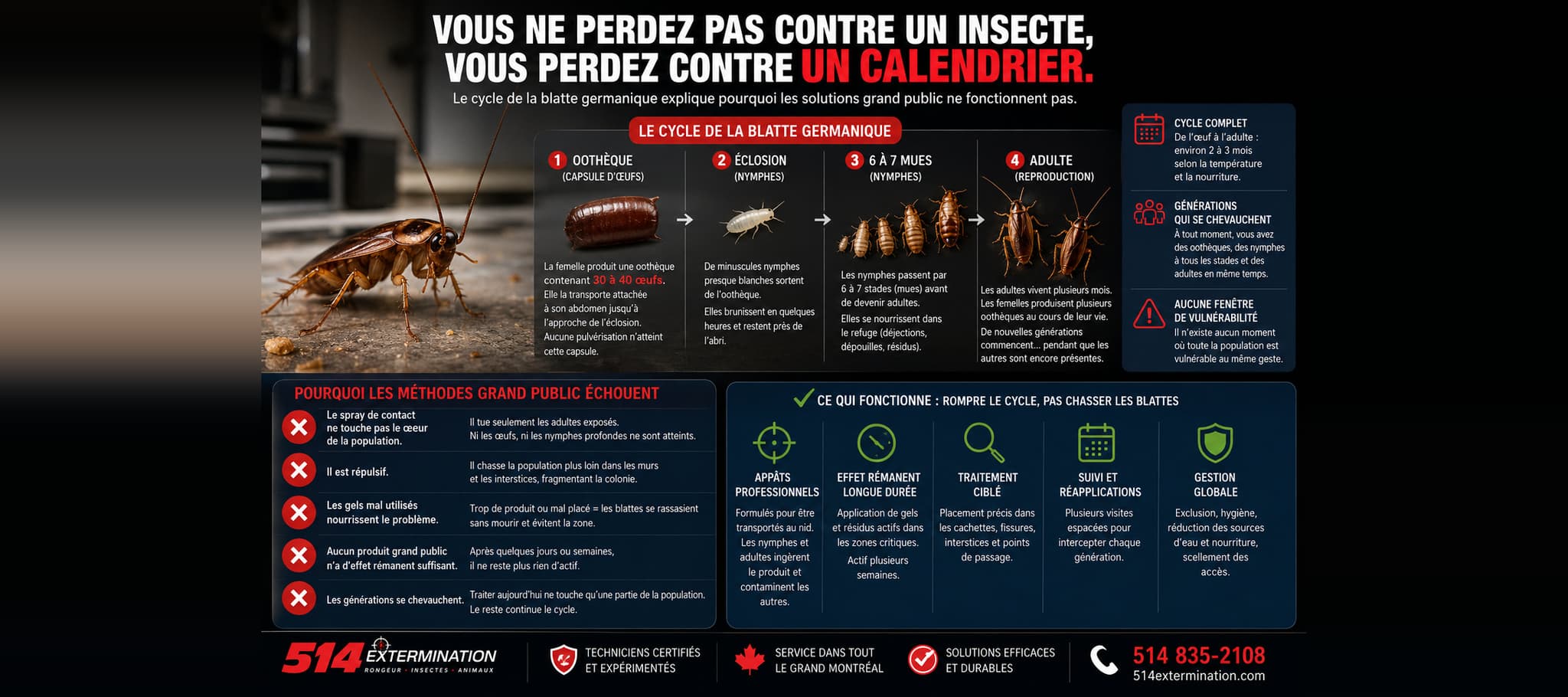
Its reproduction makes the schedule unforgiving: the female carries her ootheca until it hatches, and generations overlap. That is also why this species gets a follow-up visit — the oothecae present on treatment day hatch after the visit. Our article on the cockroach life cycle covers this.
The mouse
A mouse gets through a 6 mm opening and routinely produces dozens of droppings a day. That volume is exactly what makes it dangerous at inspection: even once gone, it leaves abundant evidence, and section 2.1.2 explicitly names droppings. The sensitive zones are goods receiving, the waste room, under pallets, and around pipe penetrations.
Drain flies
Underestimated, yet highly visible during an inspection because they fly slowly at eye level. They do not come from outside: they develop in the biofilm lining floor drains, traps and joints under sinks. An insecticide sprayed into the room does not reach them — what eliminates them is mechanically stripping the biofilm. See our article on identifying fly types.
Where the inspector actually looks
Not on the counter. The places that decide an inspection are the ones nobody cleans nightly:
- Under and behind heavy equipment — fryers, refrigerators, dishwashers. The number one spot.
- Motor housings and compressors, permanently warm.
- Mounting rails and hollow legs on stainless work tables.
- Floor drains and traps under sinks.
- The floor-to-wall joint, especially where the sanitary base is cracked or lifting.
- Dropped ceilings, particularly above cooking areas.
- The waste room and the ground around outdoor containers.
- The receiving area and pallet storage — delivery cardboard is the leading way cockroaches enter an establishment.
- Staff lockers and the break room, often left out of the treatment plan.
- The bottom of service doors and air vents, under section 2.1.5.
An operator who walks this list with a flashlight once a month sees nearly every problem coming.
Why curative work alone does not hold commercially
A treated home can stay clear for a long time: entries are rare and controllable. A food establishment cannot — for structural reasons, not negligence:
- Deliveries arrive daily, often in cardboard, carrying cockroaches from a warehouse or supplier.
- Doors open constantly during service and receiving.
- The heat never drops, removing the winter pause a residential building gets.
- Walls are shared. In a street-level commercial unit, the immediate neighbour and the alley are part of your problem, however well you maintain your own space.
Under those conditions the question is not eliminating a population once, but holding pressure at zero against continuous reintroduction. That is a different regime, and it calls for a different setup.
What a real pest management program is
Let us say it plainly first, because the opposite is sold hard: the Food Regulation does not require a pest control contract. It requires a result — premises free of pests and their droppings, and openings properly fitted. The program is not a legal obligation: it is the most reliable way to reach that result and, above all, to be able to demonstrate it.
A serious program has four elements:
- A frequency matched to risk, not a uniform package. A high-volume kitchen with a prep basement does not have the same needs as a packaged retail shop.
- Numbered, mapped devices. Each monitoring station carries a number, plotted on a floor plan. That is what lets you say "activity is concentrated around station 7, near receiving" rather than "there are mice."
- A logbook kept on site, with each visit's report, findings, products used and recommended corrections. This is the document an inspector, a franchise auditor or a HACCP verifier will ask for — and it separates an operator who reacts from one who steers.
- Trend tracking. Three catches at the same station over three consecutive visits do not read like one isolated catch. That is what the numbering is for.
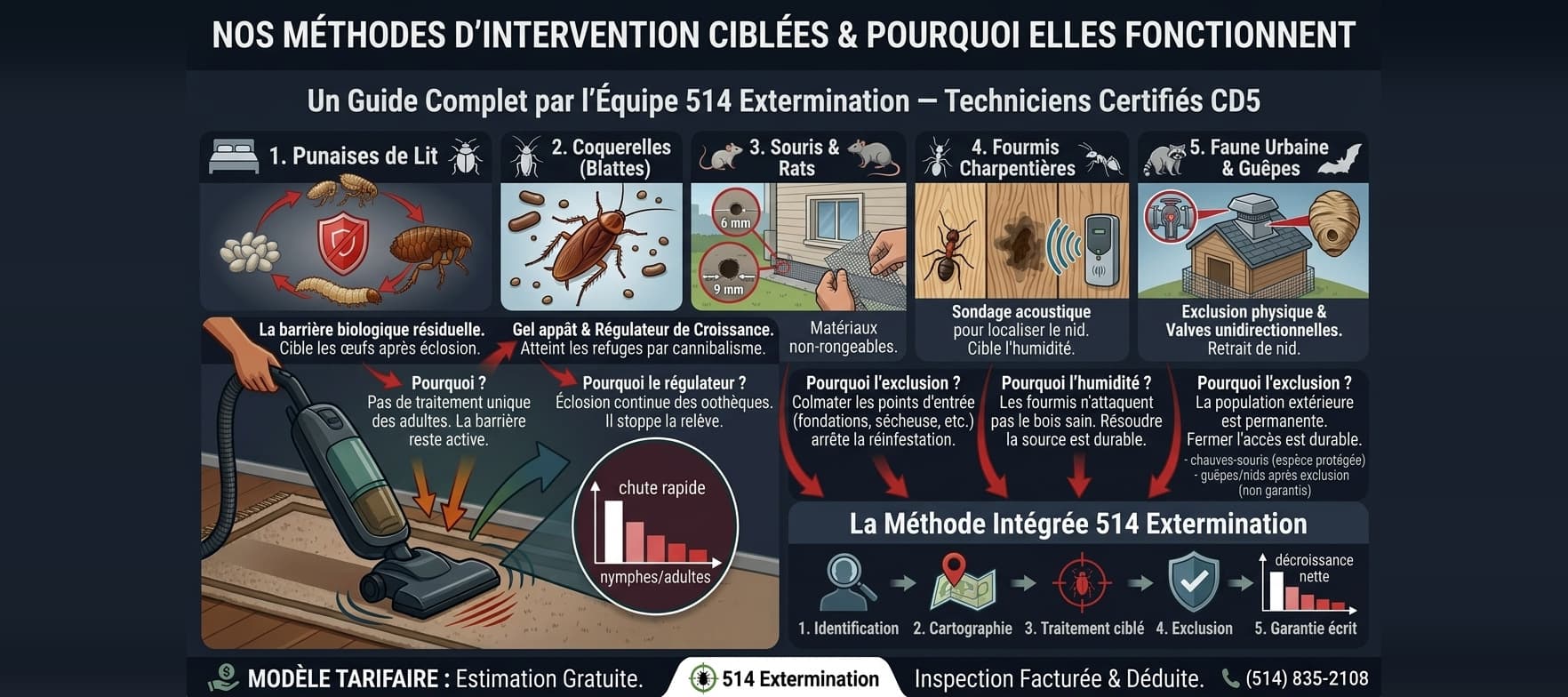
On how we work and the reason behind each technical choice, see our treatment methods.
How we work in commercial settings
Our commercial interventions across Greater Montreal are designed not to be seen:
- Outside business hours — early morning, evening or overnight, depending on your operation.
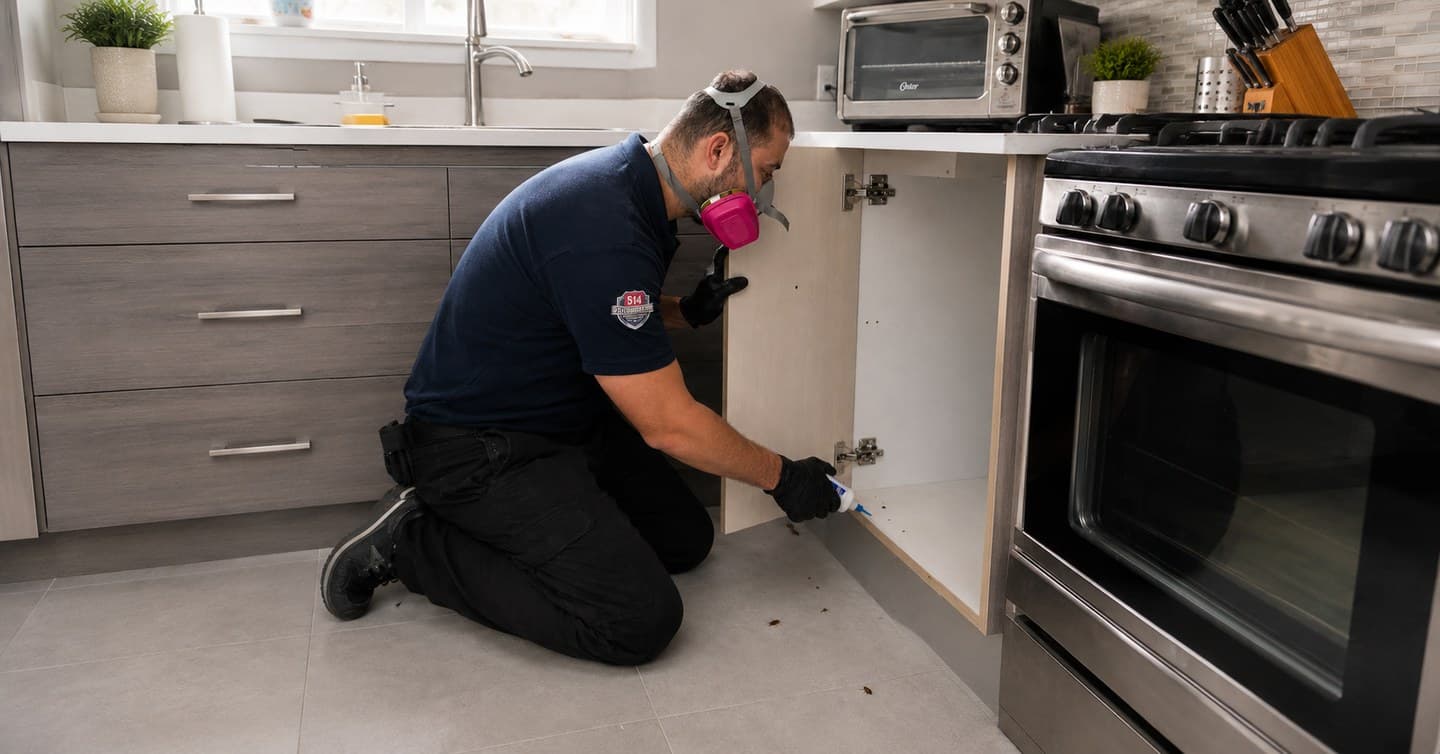
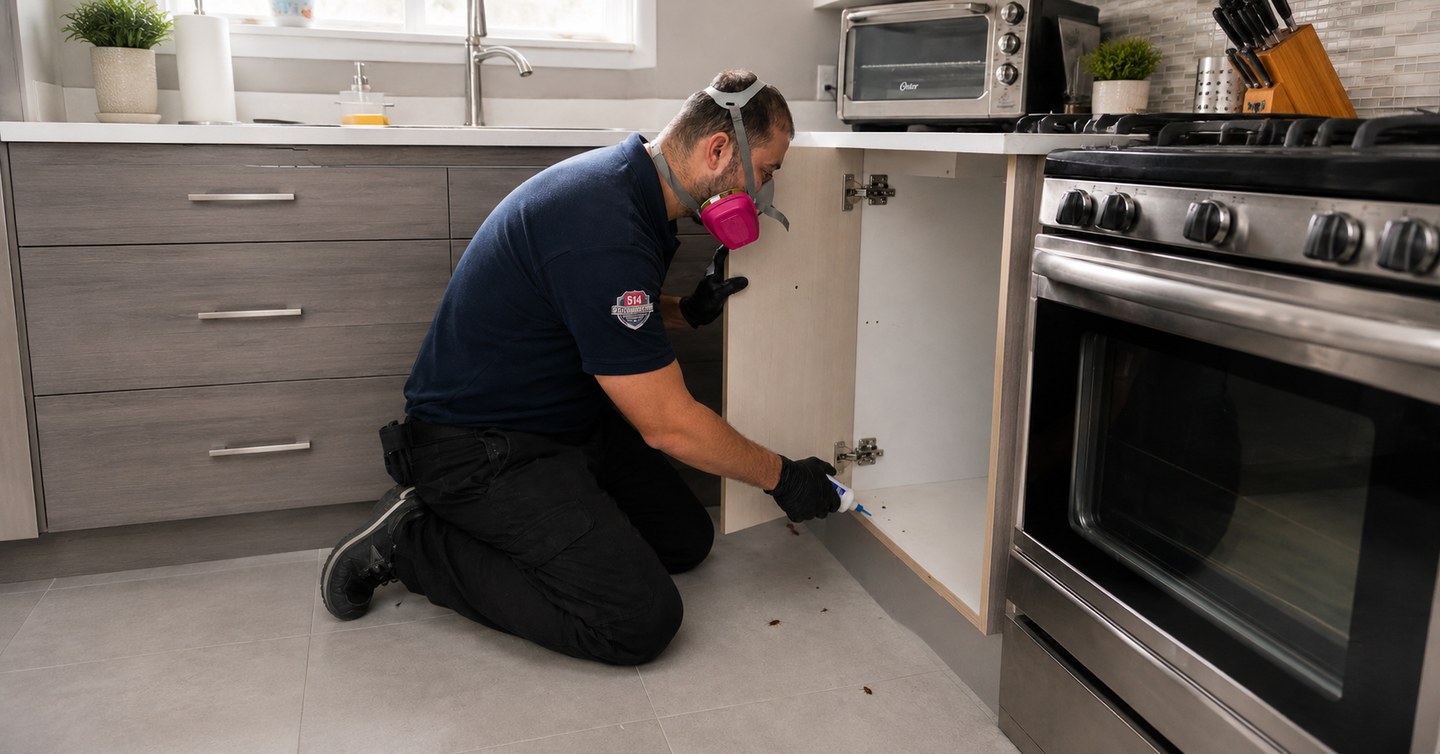
- Targeted applications into cavities — motor housings, rails, slides, joints — never onto work surfaces.
- CD5 certified technicians and Health Canada registered products. Business licence C5 no. 402574504 issued by the Ministère de l'Environnement, de la Lutte contre les changements climatiques, de la Faune et des Parcs.
- A written report at every visit, filed in the logbook you keep on site.
And one limit we state up front: we cannot guarantee the result in a unit whose exclusion defects go uncorrected. If the delivery door does not close, if the neighbouring waste room is not maintained, if a shared wall backs onto an infested business, treatment compensates without resolving. We write that in the report rather than returning indefinitely without saying so. The terms of our guarantee are published.
The first exchange is a free price estimate, by phone or on site depending on the size of the file. The detailed inspection is billed — and deducted from the price of the treatment if you go ahead.
Beyond food service
The regulatory framework above targets food establishments, but the requirement to deliver a result exists elsewhere in other forms:
- Hotels and lodging — the dominant issue is bed bugs, where the real cost is the online review and the out-of-service room, not the treatment. A report handled within 48 hours costs a fraction of a floor-wide spread.
- Apartment buildings and condominiums — the landlord's or syndicate's responsibility is framed by the Civil Code. See landlord rights and our guide for condominium syndicates.
- Daycares and care settings — product constraints and re-entry intervals outweigh speed.
- Warehouses and offices — the problem almost always starts at the loading dock and with waste handling, rarely inside.
Our commercial pest control page details how each type of establishment is handled.
Summary table
| Question | Short answer |
|---|---|
| Who inspects in Montreal? | The City's Food Inspection Division, acting as MAPAQ's agent |
| What is the tolerated threshold? | None — premises must be "free of" pests, droppings included (s. 2.1.2) |
| Are openings covered? | Yes — doors, windows, screens and air vents (s. 2.1.5, para. 3) |
| Is a contract mandatory? | No. The regulation requires a result, not a contract |
| Is a conviction public? | Yes — MAPAQ for 24 months, Montreal open data since 2011 |
Sources
- Food Regulation (RLRQ, chapter P-29, r. 1), sections 2.1.2 and 2.1.5, quoted from the Aide-mémoire pour les exploitants d'établissements de restauration et de vente au détail published by MAPAQ.
- City of Montreal, Inspection des aliments — the City inspects as MAPAQ's agent.
- MAPAQ, Condamnations des établissements alimentaires — last 24 months published.
- City of Montreal open data, Inspections des aliments et contrevenants dataset — updated monthly, history since January 2011.
This text presents the regulatory framework for information purposes and does not constitute legal advice. For a specific situation, consult the Food Inspection Division or a legal advisor.
For an establishment in Montreal, Laval, the South Shore or the North Shore, call us at (514) 835-2108.
Frequently Asked Questions
Who inspects restaurants in Montreal, MAPAQ or the City?
How many cockroaches are tolerated in a commercial kitchen?
Is a pest control contract mandatory for a restaurant in Quebec?
How long does a conviction stay public?
How do cockroaches get into a well-kept restaurant?
Can you treat without closing the restaurant?
Need a professional exterminator?
Contact us for a free evaluation and a treatment plan tailored to your situation.