Pest Infestation: A Landlord's Rights Regarding the Tenant, and What to Do
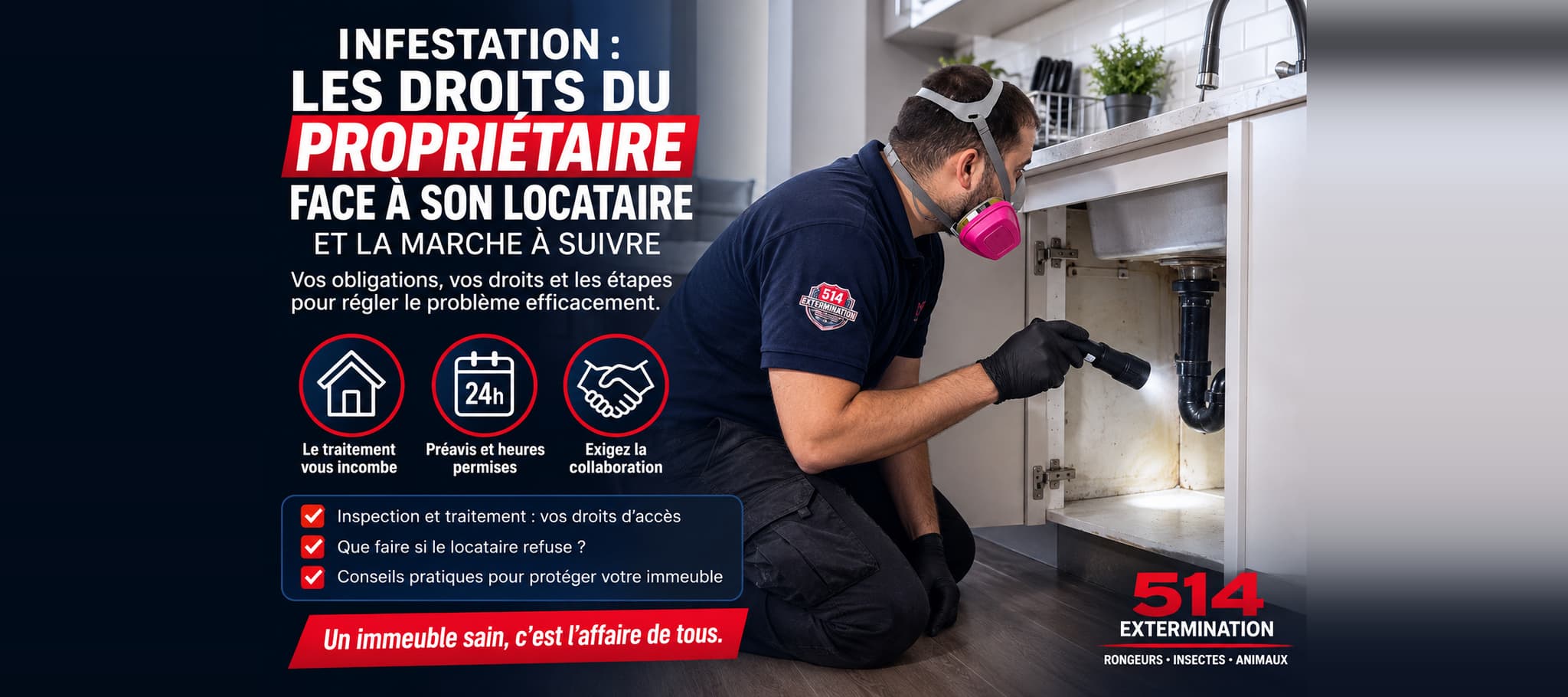
Treatment is your responsibility — but you have the right to enter, inspect and require the tenant's cooperation. Here are the notice periods, permitted hours, and what to do when access is refused.
The short answer
Two things are true at once, and that is what makes these files confusing.
Treatment is your responsibility. Articles 1854 and 1910 of the Civil Code of Québec require you to deliver a dwelling in good habitable condition and maintain it so for the entire lease. Vermin undermines that habitability. The obligation is public order: no lease clause can shift it to the tenant.
But you have rights in order to carry it out. You may enter to verify the condition of the premises, enter to do the work, and require the tenant's cooperation. If they refuse, you have remedies — up to resiliation of the lease in serious cases.
This article sets out the notice periods, the permitted hours, and what to do when things stall. The counterpart, from the tenant's side, is here.
First, what you owe
Starting with your obligations is not a concession: it is what decides the outcome before the rental board. A landlord who delayed arrives in a weak position, whatever the tenant's attitude.
- Articles 1854 and 1910: deliver and maintain the dwelling in good habitable condition.
- Article 1913: neither offer for rent nor deliver a dwelling unfit for habitation.
Case law is demanding on vermin: you must act without delay and use competent professionals. The courts treat it as an obligation of result, not of means. "I tried" does not suffice.
Practical consequence: the clock starts at the first report. A file opened and documented within 48 hours protects you; three weeks of silence exposes you to an order, a rent reduction or damages.
Right of access: notice and permitted hours
This is the most useful part of this article, and the least known on both sides. The Civil Code distinguishes three situations, with different rules.
Verifying the condition of the dwelling (inspection)
- 24 hours' notice to the tenant, except in an emergency (article 1931).
- The tenant may refuse before 9 a.m. and after 9 p.m. (article 1932).
- They may also refuse, in all cases, if you cannot be present.
Carrying out work (the treatment itself)
- The tenant may not refuse access when you must carry out work there (article 1933).
- They may, however, refuse before 7 a.m. and after 7 p.m. — unless the work is urgent.
- The 24-hour notice under article 1931 applies as well.
Emergencies
In an emergency, notice is not required. But "emergency" has a precise meaning: your schedule does not define it, the risk does. An active infestation spreading to neighbouring units may qualify; a routine inspection does not.
Give notice in writing and keep it. Verbal notice exists in law, but it cannot be proven — and before the tribunal, what you cannot prove did not happen.
Acting on suspicion alone
You do not need a complaint from the tenant concerned in order to act. Reasonable suspicion justifies an inspection: a report in the neighbouring unit, traces in the shared laundry room, abnormal waste, or a previous case in the building.
The process is the same: written 24-hour notice stating the date, the time window, the reason, and that a technician will accompany you. Stay factual — a notice written like an accusation puts the occupant on the defensive and complicates everything that follows.
In a plex, that inspection should never stop at the suspected unit. Plumbing stacks and electrical chases connect the floors, and a population can move between units without ever using a door. We explain that mechanism in detail here.
What you can require of the tenant
Their obligations are real, and they mirror yours:
- Articles 1855 and 1911: use the dwelling with prudence and diligence, and keep it clean.
- Article 1866: inform you of defects and deterioration. A tenant who conceals an infestation for months breaches that duty.
- Article 1860: not disturb the normal enjoyment of the other occupants. This is the article that gives weight to a building file: refusing to cooperate harms not only you but the neighbours.
- Articles 1931 to 1933: allow access, under the conditions above.
Add to this the preparation of the dwelling before treatment. It has no dedicated article, but it follows from the duties of cooperation and prudence — and technically it largely decides the outcome. The protocol we issue is public, which lets you show the instructions were properly conveyed.
If the tenant refuses: the steps
Order matters, and skipping a step weakens the next one.
1. A written, factual notice
Date, time window, reason, name of the company attending. Send it so you can prove receipt. Keep a copy.
2. A second attempt, documented
Record the absence or refusal: date, time, what happened, witnesses if any. A technician who travels for nothing can note it in their report — that is evidence dated by a third party.
3. A formal notice
It restates the obligations, sets a specific deadline and states what follows. It is often the step that unblocks the file.
4. An application for an access order
If the tenant refuses access without a ground provided by law, you may apply to the rental board for an access order. That is the normal route, and it works in most cases.
5. Resiliation, as a last resort
Article 1863 provides that non-performance of an obligation gives the other party the right to specific performance and, where the non-performance causes serious prejudice, to resiliation of the lease. Case law has resiliated leases for persistent refusal to cooperate with bed bug treatment, on the basis of the prejudice caused to the building's other occupants.
But be precise about the threshold: this is not a first step. Such decisions generally follow an order already rendered and ignored, repeated written notices, and demonstrated prejudice. A landlord seeking resiliation after a single missed appointment will be sent back to their own duties.
Can you bill the treatment to the tenant?
It is the question most landlords ask first, and the default answer is no.
Extermination flows from your habitability obligation. You cannot bill the tenant merely because they reported the problem, nor because you assume they "brought it in". A lease clause providing otherwise has no effect, since the obligation is public order.
A claim is only conceivable if you establish fault on the tenant's part — and the burden is yours. More defensible:
- Persistent refusal to cooperate, which caused an already-paid treatment to fail and made a second one necessary.
- Failure to prepare the dwelling despite written instructions sent and received.
- Insalubrity attributable to the occupant and left uncorrected despite notices.
Much weaker: "they just got back from a trip", "they bought second-hand furniture", "it must be them". Those are hypotheses, not evidence — and the tribunals treat them as such.
Our position on this is simple, and it concerns you too: we do not sell a treatment to an occupant when the obligation lies with the owner.
Buildings: treat at building scale
This is where landlords lose the most money, and rarely for the reasons they think.
Treating only the complaining unit costs less at the start and more at the end. In a plex, plumbing penetrations and electrical chases are rarely firestopped between floors: the population relocates instead of disappearing, and comes back. What would have cost one intervention costs three.
Two reflexes that change a file's trajectory:
- Inspect the adjoining units — beside, above, below — at the first report, even without a complaint. In an early infestation, the occupant sees nothing for weeks.
- Treat the shared laundry room first where there is one: that is where bed bugs move between units, in laundry baskets.
Our building protocol, with access coordination and the preparation schedule, is detailed here.
The documentation that protects you
A landlord's file is won on the same basis as a tenant's: what you can show.
- The report received, dated, and your response — with the interval between them.
- The 24-hour access notices, and proof they were sent.
- The intervention reports, including those for visits where access was refused.
- The preparation instructions issued, with the date sent.
- In Montreal, the declarations to the City. Every bed bug extermination must be declared within 5 days, and the obligation rests on the exterminator. We detail that mechanism here. That official history serves you in a dispute, and when selling the building.
This is what we provide as a matter of course: written report, itemised invoice, species identification, and compliant declaration. Our numbers — C5 business permit no. 402574504 and CD5 applicator certificates — appear on every report. An intervention by an uncertified company weakens your case as much as your treatment.
Request a free inspection here, or call us at (514) 835-2108.
Disclaimer
This article provides general information on the framework applicable in Quebec. It is not legal advice and does not replace a consultation. Every situation turns on its own facts. For guidance, contact the Tribunal administratif du logement, a landlords' association, or a lawyer.
Sources
Lessor and lessee obligations, non-performance and resiliation: Civil Code of Québec, articles 1854, 1855, 1860, 1863, 1866, 1910, 1911 and 1913. Access to the dwelling, 24-hour notice and permitted hours: Civil Code of Québec, articles 1931, 1932 and 1933. Lessor remedies for refusal of access and resiliation for failure to cooperate with treatment: Tribunal administratif du logement and Quebec case law reported by SOQUIJ and CORPIQ. Obligation to declare bed bug extermination interventions: City of Montreal, By-law concerning the sanitation, maintenance and safety of dwelling units.
Frequently Asked Questions
How much notice must I give to inspect a dwelling?
Can the tenant refuse access for the treatment?
Can I bill the extermination to the tenant?
Can I inspect on suspicion alone, without a tenant complaint?
Can I resiliate the lease of a tenant who refuses to cooperate?
Should I treat neighbouring units even without a complaint?
Need a professional exterminator?
Contact us for a free evaluation and a treatment plan tailored to your situation.