Mouse or Rat? How to Identify the Rodent in Your Home
You haven't seen the animal, only droppings? That is often enough. Dropping size, the width of gnaw marks and where it travels are usually enough to decide — and the treatment depends entirely on it.

In brief
The best clue is the droppings. A mouse's measure 3 to 6 mm, about the size of a grain of rice; a Norway rat's, 2 to 2.5 cm. Gnaw marks confirm it: 1 to 2 mm wide for a mouse, about 4 mm for a rat. Location matters too: a mouse often lives entirely indoors, in walls and cabinets; the Norway rat digs burrows outside and must drink every day. A third possibility is worth knowing in Quebec: the deer mouse, with a white belly and feet, which comes in during the fall near fields and woods and can transmit hantavirus. Identifying the right rodent determines trap size, how traps are set and which openings need closing.
Why identification changes everything
Mice and rats are not treated the same way:
- Traps are not interchangeable. According to the University of California, a mouse or young rat often won't trigger a rat trap, and a mouse trap won't kill an adult rat.
- Behaviour differs. Mice are curious and get caught quickly. Rats avoid any new object for several days, sometimes weeks: traps have to be left unset before setting them.
- The area to cover is not the same. A mouse stays within about ten metres of its nest. A Norway rat ranges over 30 to 150 metres.
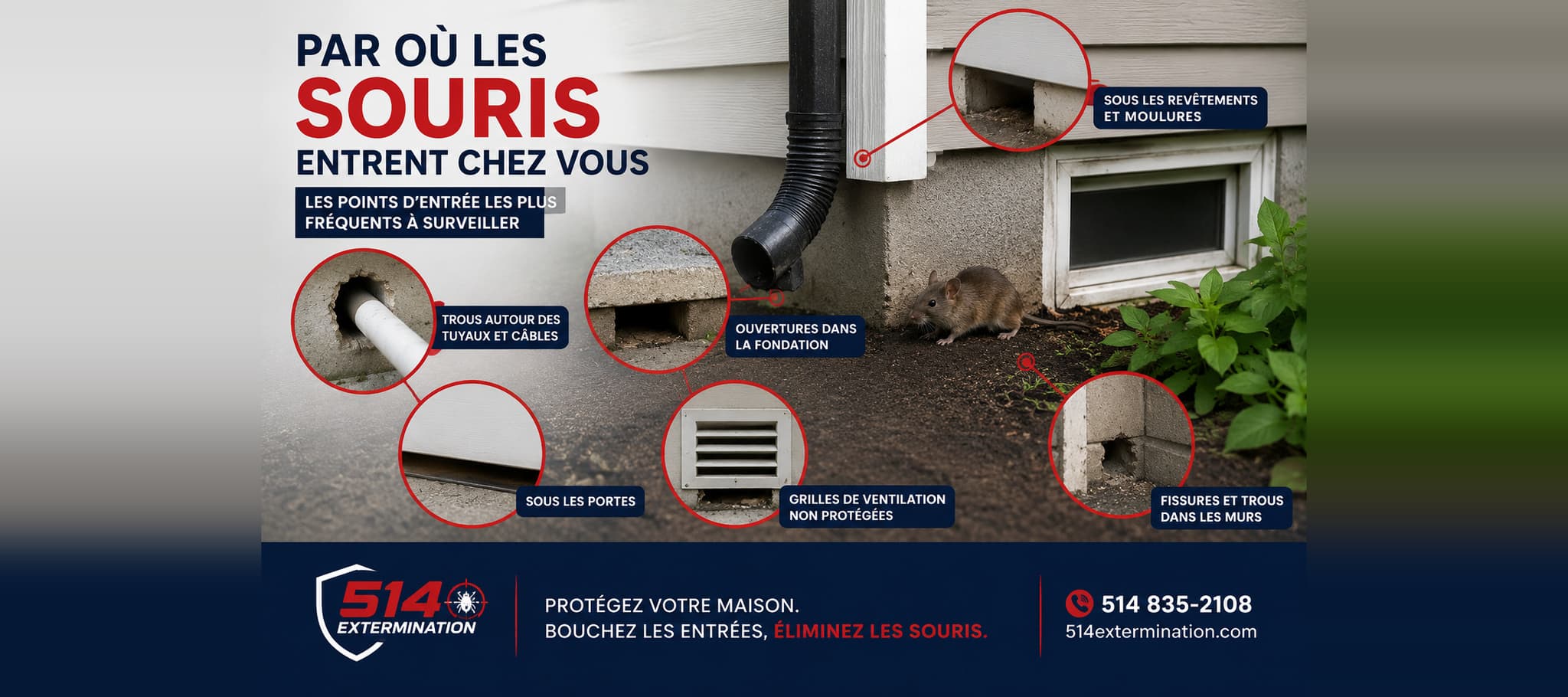
- Nor are the openings to close. A mouse fits under a 6 mm gap; a young rat under a gap of about 12 mm.
And with a deer mouse, cleaning requires special precautions because of hantavirus.
Clue no. 1: droppings
It is the first sign people find, and the most reliable way to tell them apart.
- Mouse: 3 to 6 mm long (1/8 to 1/4 inch according to Cornell University), thin, rod- or rice-grain-shaped. Scattered along runways, in drawers, under the sink, behind appliances.
- Norway rat: 2 to 2.5 cm long (3/4 to 1 inch), thick, capsule-shaped. More clustered, often in the basement or near water.
Fresh or old? According to the University of Florida, fresh droppings are black, shiny and soft; old ones are grey, dusty and crumble. Only old droppings may point to a past problem. To be sure, clean an area and check again a few days later.
One caveat: a young rat leaves smaller droppings than an adult. If you find in-between sizes, look for other clues.
Do not sweep or vacuum them: Health Canada recommends wetting them with a water and bleach mixture and picking them up with gloves.
Clue no. 2: gnaw marks and tracks
Rodents gnaw to wear down their incisors, which never stop growing. The width of the mark gives away the animal's size:
- Mouse: fine marks 1 to 2 mm wide that look like scratches. Typical on cereal boxes, pet food bags, paper.
- Rat: marks of 3.5 to 4 mm, deeper. A rat can chew wood, plastic or electrical wires, and leaves holes with rough edges.
Tracks show up in basement dust or in a thin layer of flour spread along a wall: about 1 to 2 cm for a mouse, 2 to 3 cm for a Norway rat. Rats also leave greasy rub marks on the walls and beams they follow: their fur deposits dirt and oil at body height.
Clue no. 3: the animal itself
If you caught a glimpse, a few details are enough. According to the Canadian Conservation Institute:
- The house mouse measures about 17.5 cm including the tail, weighs around fifteen grams, has a pointed muzzle, large ears and greyish-brown fur.
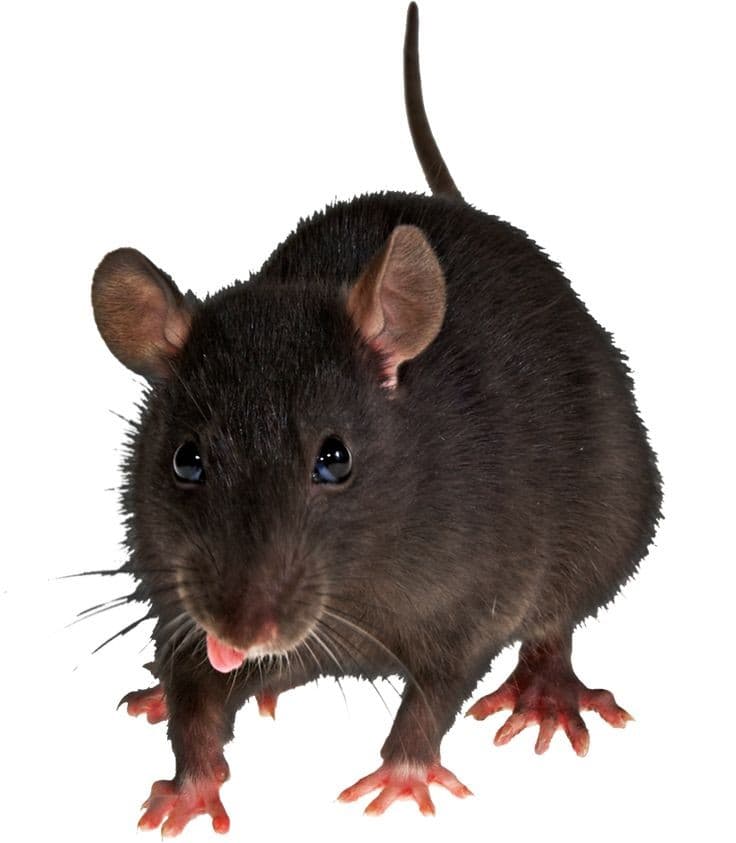
- The Norway rat (brown rat, sewer rat) measures 30 to 45 cm including the tail, can weigh up to half a kilo, has a rounded muzzle, small thick ears and brown fur with a pale grey belly.
- The roof rat, slimmer, has a pointed muzzle and large thin ears. It climbs and nests high up. In Quebec, the two rodents living alongside people are mainly the house mouse and the Norway rat.
The classic trap: the young rat. It can be the size of a large mouse. The University of California gives the test: a young rat has a very large head and feet for its body; an adult mouse has a proportionally small head and feet.
Clue no. 4: where it lives and where you hear it
- The mouse can spend its whole life indoors. It nests in walls, cabinets, appliances and insulation, and gets most of its water from its food. An agile climber, it is often heard in walls or ceilings, even on upper floors.
- The Norway rat digs burrows in soil: yards, flower beds, under slabs and sheds. It must drink every day. Indoors it is mostly found in the basement, near drains and water. Holes in the ground along the foundation are a strong sign.
Sound helps too: a mouse makes light, quick scratching; a rat makes heavier noises and audible gnawing. Our article on noises in the walls details diagnosis by ear.
What about the deer mouse?
This is the third possibility, and it deserves special attention. The deer mouse (white-footed mouse and related species) is recognized by its white belly and feet, a sharp line between its dark back and pale belly, large prominent eyes, and a furred two-tone tail, dark on top and white underneath. The house mouse's tail, by contrast, is almost bare.
According to Health Canada, it mostly comes in during the fall in buildings near fields and woods: cottages, homes at the edge of a forest, sheds, garages. The Canadian Conservation Institute notes it can transmit hantavirus through its droppings and saliva. Cleaning a place used by deer mice therefore calls for strict precautions: ventilate, wet before picking up, gloves, never a broom or vacuum. Our article on hantavirus details the steps.
Diagnostic table
| House mouse | Norway rat | Deer mouse | |
|---|---|---|---|
| Droppings | 3 to 6 mm, thin, rod-shaped | 2 to 2.5 cm, thick, capsule-shaped | Similar to the house mouse |
| Gnaw marks | 1 to 2 mm, shallow | 3.5 to 4 mm, deep | Small, like the mouse |
| Size (with tail) | About 17.5 cm | 30 to 45 cm | 15 to 20 cm |
| Distinctive sign | Almost bare tail, even coat | Rounded muzzle, small ears | White belly and feet, two-tone tail |
| Where | Walls, cabinets, every floor | Burrows outside, basement, near water | Buildings near fields and woods, in the fall |
| Precaution | Gloves, bleach | Gloves, bleach | Hantavirus: strict precautions |
What it changes for treatment
Against mice: many traps, close together, along walls, where the droppings are; then closing every opening larger than 6 mm with chew-proof materials. Our article on mouse traps details placement.
Against rats: sturdier rat traps, left unset for several days to overcome their wariness; searching for burrows and entry points at ground level and around drains. See our article on rats and their dangers.
In both cases the same rule applies: nothing gets sealed while rodents are still inside, and poison alone does not fix the cause.
Sources
- Health Canada, Rats and mice (pest control tips).
- Canadian Conservation Institute, Main rodent pests.
- Cornell University, Integrated Pest Management, Mouse and Rat Biology and Behavior.
- University of California Statewide IPM Program, Pest Notes: House Mouse (2025) and Pest Notes: Rats.
- University of Florida IFAS Extension, Rat and Mouse Control (DH044).
Not sure what you have? Send us a photo of the droppings or marks, or ask for a free price estimate at (514) 835-2108. The on-site inspection is billed and deducted from the price of the treatment if you go ahead.
Frequently Asked Questions
How can I tell whether I have a mouse or a rat?
What do mouse droppings look like?
Is it a baby rat or a mouse?
How do I recognize a deer mouse?
Can a mouse trap kill a rat?
Need a professional exterminator?
Contact us for a free evaluation and a treatment plan tailored to your situation.