Bed Bugs: How Long Does It Take to Get Rid of Them?
A bed bug treatment does not produce a result the same evening, and that is normal. Here is the real timeline, day by day, and the three factors that separate three weeks from three months.
In brief
After a professional bed bug treatment, expect about three weeks before activity ends completely. That delay is not slowness: it matches the incubation time of the eggs, which residual products do not destroy effectively. Eggs already laid hatch over six to ten days, and the nymphs that emerge must then cross the residual barrier to die. Seeing a bed bug on day 5 is expected. Seeing a new one on day 25 is not. At 514 Extermination, the treatment is done in a single visit, with a one-month guarantee that covers precisely this observation window.
The short answer: about three weeks
That is the figure we give our clients in Montreal, and it holds in the large majority of residential cases. Three weeks between the treatment and the point where the home is genuinely clear.
It is not three weeks of bites. Activity drops sharply within 48 to 72 hours: adults and nymphs already present contact the product and die. What takes three weeks is finishing off the next generation — the one still inside the egg on treatment day.
Longer cases exist. They almost always have an identifiable cause, and we list them below.
Why not the same evening
The question deserves a technical answer, because it determines everything else.
A bed bug treatment relies on a residual barrier: a product deposited on the surfaces the insect must cross to reach its host — mattress seams, bed frame, baseboards, furniture undersides, outlet surrounds. The bug does not die at the moment of application; it dies walking across it later, on its next trip toward the bed.
But a bed bug does not travel every day. An adult typically feeds every five to ten days. A bug that fed just before the treatment can stay tucked in a crack for a week before coming out — and therefore before meeting the product. That is the first reason for the delay.
The second matters more: the eggs.
The eggs: the real reason for the delay
A female lays one to five eggs a day, glued into cracks by an adhesive substance. These eggs are about a millimetre long and have two properties that complicate everything:
- They resist products. The eggshell is barely permeable. Most registered residual insecticides have weak or no ovicidal action. You do not kill a bed bug egg with the product that kills the adult.
- They are glued out of reach. Females lay in the narrowest cracks, often inside the bed structure or behind a baseboard, where no contact application arrives.
The strategy is therefore not to destroy the eggs but to wait for the nymphs. At normal room temperature — 22 to 26 °C, which is a heated Montreal home — incubation takes six to ten days. In a cooler space, a basement for instance, it stretches out.
The nymph that hatches must feed within the following days. To do so, it crosses the barrier. It dies. That is exactly what the product's residual life is meant to cover: the period over which hatching is spread.
Six to ten days of incubation, plus a few days for the last nymph to start moving, plus a safety margin: you arrive at three weeks.
The timeline, day by day
Here is what you should observe in a case that unfolds normally.
- Day 0 — the treatment. Inspection, then targeted application. The home can be re-entered after the interval stated in the guidance handed over on site.
- Days 1 to 3 — sharp drop. Active adults and nymphs die. You may find dead or dying bugs, often out in the open, moving erratically. That is a good sign: it is the product working.
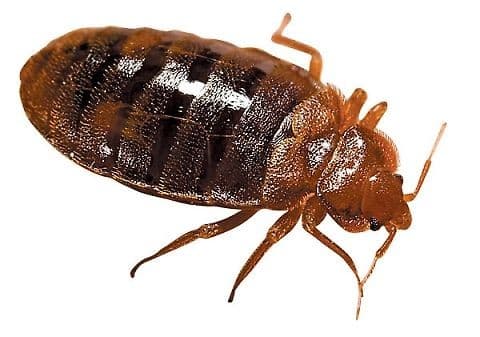
- Days 4 to 10 — the worry zone. This is when the phone rings. The first hatchings occur, and newly hatched nymphs are visible before they die. They are tiny, almost translucent. Their presence does not mean the treatment failed: it means it is working on schedule.
- Days 10 to 21 — extinction. Late hatchings become rare. Sightings turn occasional, then stop. New bites cease.
- After day 21. No new bites, no live bugs, no new marks on the seams. The case is closed.
Bites that continue: what that means
Two things get confused constantly and need separating.
An old bite can appear late. The skin reaction to a bed bug bite is not immediate in everyone. In some people it takes several days to show, and the itching can last more than a week. A mark appearing on day 4 may therefore correspond to a bite received on day 0, before the treatment.
A new bite is a bite on intact skin, appearing after a night with no marks. That is the one to count.
The practical rule: draw no conclusion before day 10. Write down dates instead. A simple log — "night of the 5th to the 6th: two new marks on the right forearm" — beats a general impression, and helps us directly if we have to come back.
Three factors that stretch the timeline
When a case runs past three weeks, the cause is almost always on this list.
1. Clutter
A cluttered bedroom offers hundreds of unreachable hiding places: piles of clothing on the floor, boxes under the bed, papers, open suitcases. Every untreated hiding place is a reservoir. This is factor number one, and it is also the one the client controls most. Our preparation guidance is not paperwork: it determines how long the case lasts.
2. The neighbours
In an apartment building, a treated unit surrounded by infested units gets reinfested. Bed bugs travel through electrical chases, shared baseboards and corridors. No treatment makes a unit sealed against its neighbours.
This is also the explicit limit of our guarantee: it does not cover reinfestation from an untreated neighbouring unit. If you are in a building, the real fix runs through the landlord and a coordinated treatment of adjacent units. Our article on tenant rights during an infestation explains the steps.
3. Partial preparation
Washing laundry without sealing it afterward, moving a mattress into the hallway, shifting furniture from room to room during treatment: each of these scatters the infestation instead of concentrating it. A well-executed treatment in a poorly prepared home gives a worse result than an average treatment in a well-prepared one.
What shortens the timeline
Conversely, four things genuinely speed up the end of a case:
- Early detection. A three-week-old infestation is resolved faster than a six-month-old one, simply because fewer eggs have already been laid. Our article on the signs that do not lie helps you avoid losing those weeks.
- Complete preparation. See above. It is the most powerful lever available to the client.
- Normal occupancy of the home. Counter-intuitive, but true: do not desert the bedroom. A bed bug moves because it detects a host — warmth, CO₂. An empty bed triggers nothing, and the insects stay tucked away instead of crossing the barrier. Sleeping elsewhere in the home also pushes the bugs to follow you, which spreads the infestation to a second room.
- Certified bed bug encasements on the mattress and box spring, fitted after the treatment and left in place for at least a year. They trap whatever remains inside the mattress and permanently remove the main harbourage.
How to know it is really over
The absence of bites is a clue, not proof: roughly one person in five shows no visible reaction to bed bug bites. Three checks beat one impression.
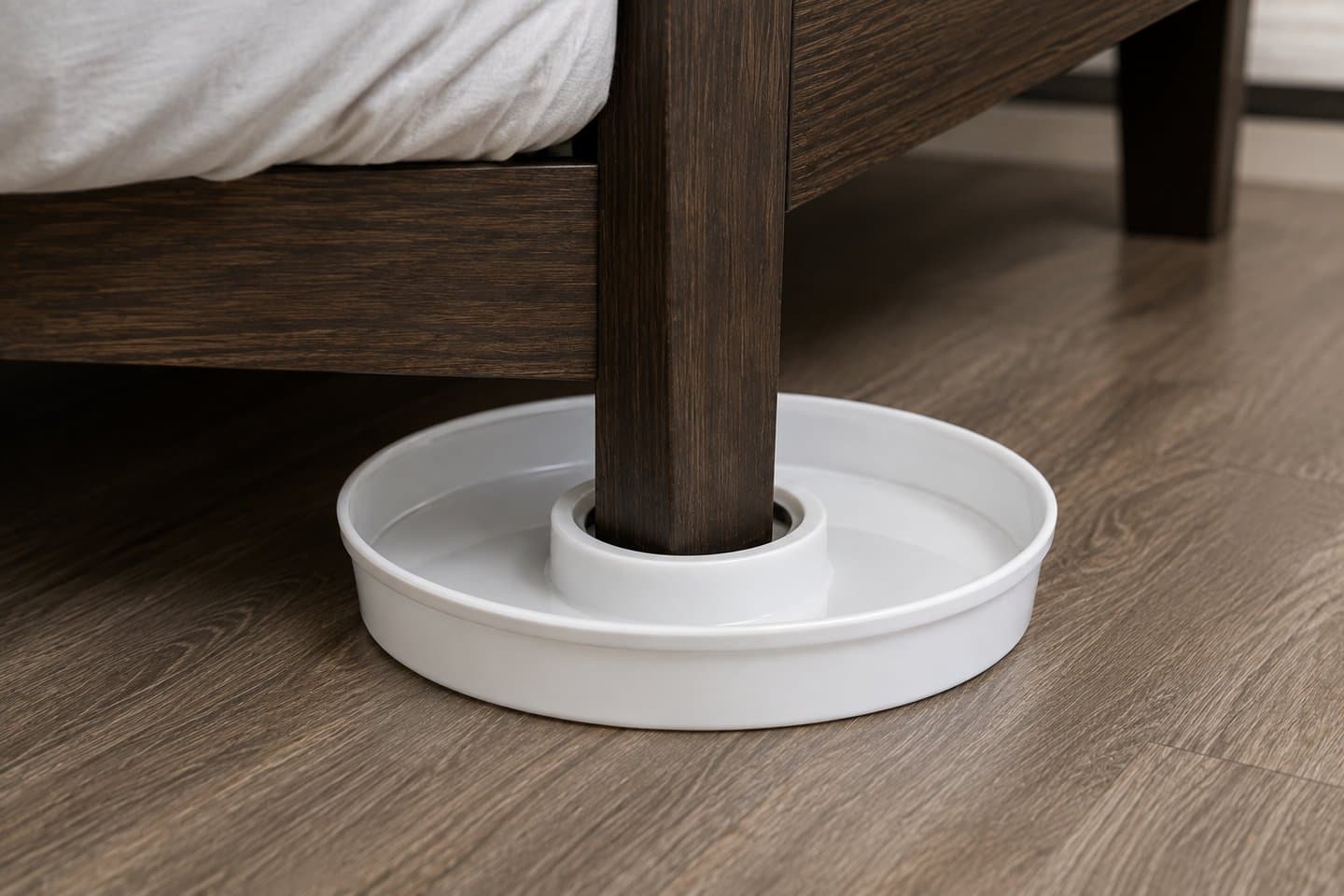
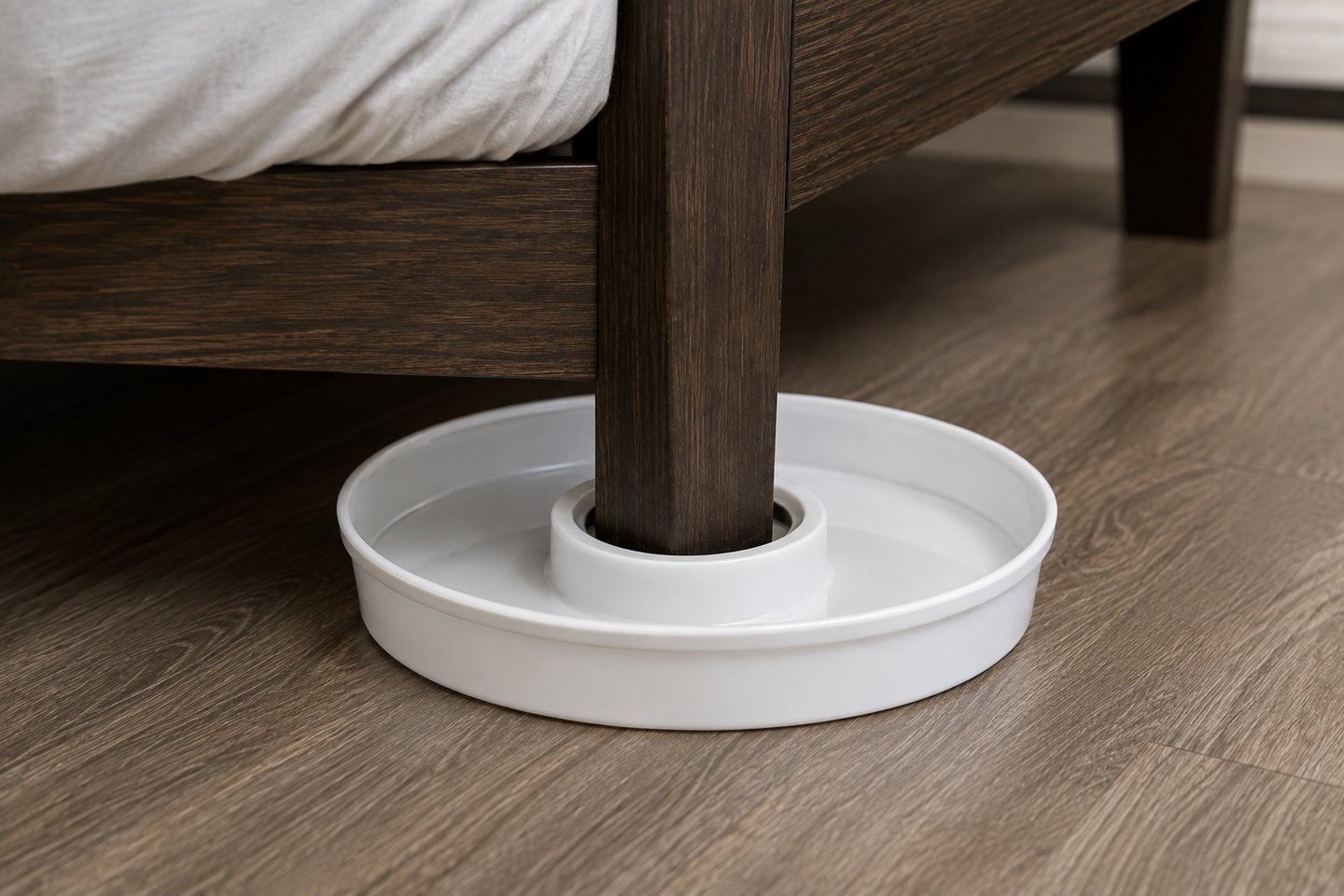
- Interceptors. Place an interceptor cup under each bed leg and under the legs of the bedroom chair. Check them once a week. Three consecutive weeks with no catch is a solid result.
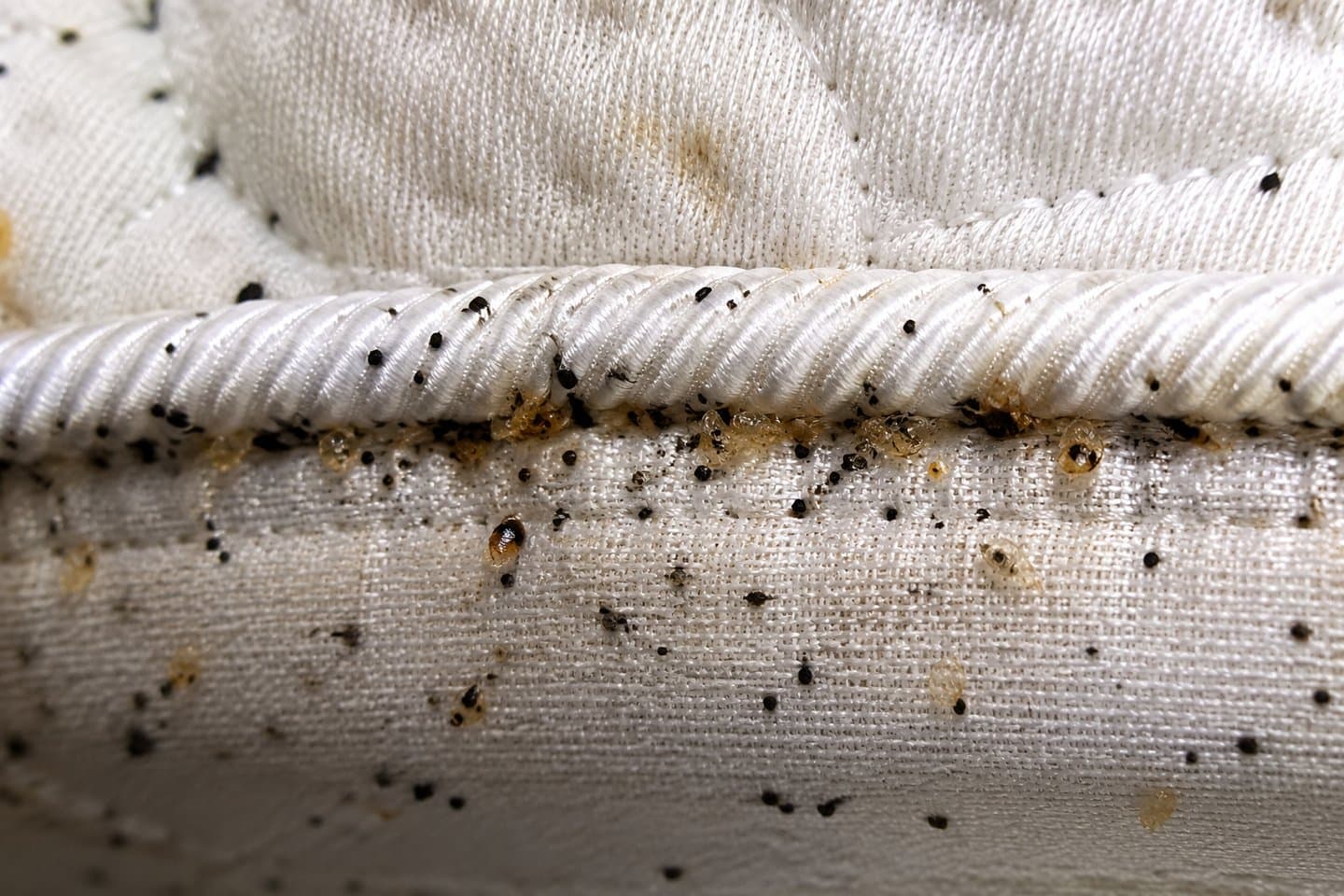
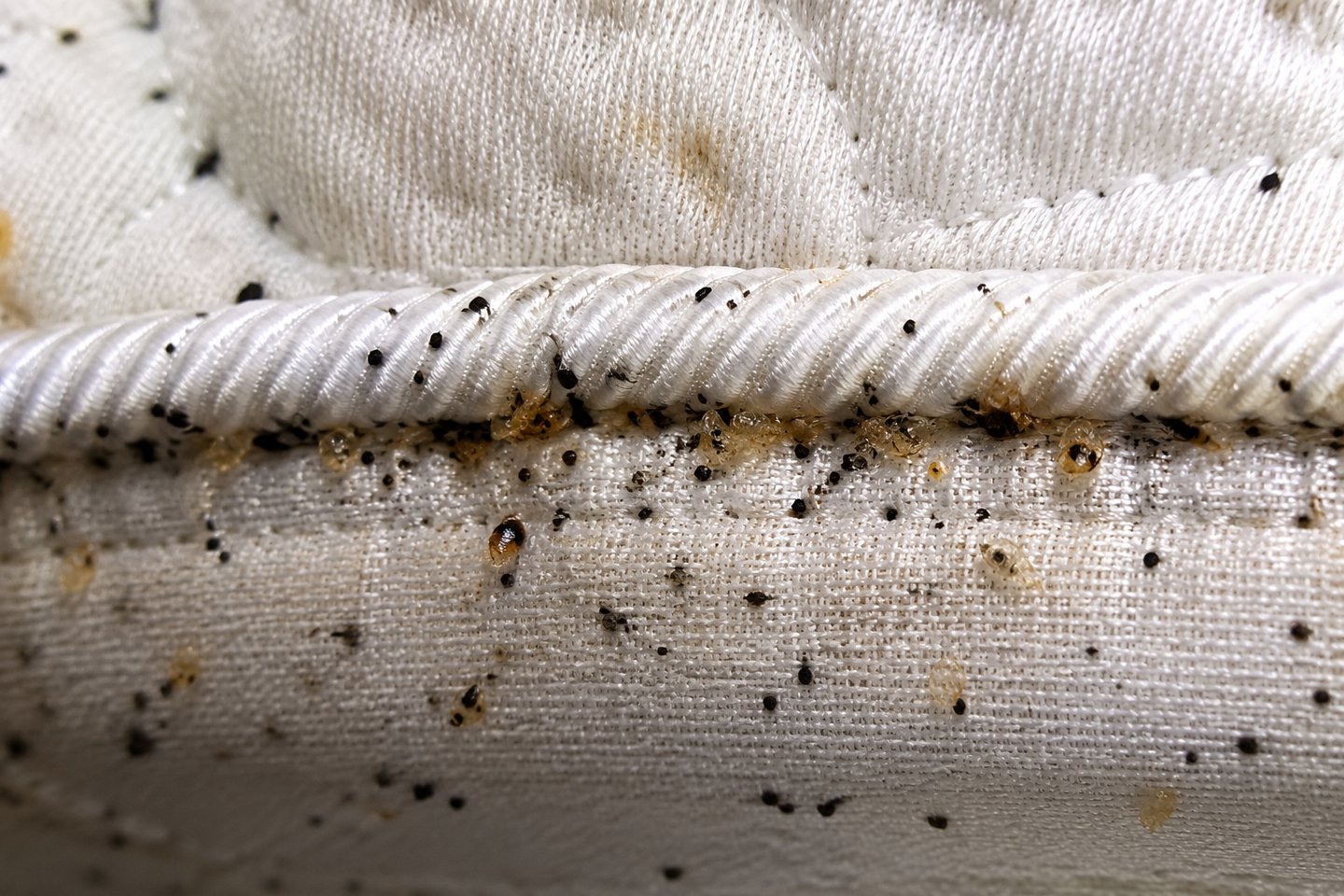
- Seams and baseboards. Inspect with a flashlight held at a grazing angle. You are looking for fresh black specks — the droppings — and shed skins. Photograph the areas on day 0: you will then know what is old and what is new.
- Twenty-one days with no new bite in a normally occupied home.
With those three signals together, the case is closed.
Our approach: a single visit
Many companies announce two or three visits spaced two weeks apart from the outset. Our protocol aims for one complete intervention, and that needs explaining, because it is not a saving made at the client's expense.
A multi-visit protocol assumes the first pass does not cover everything — that someone will come back. Ours assumes the opposite: the inspection identifies every harbourage before anything is applied, and the application covers every travel route in one go, with a residual life chosen to last through the entire hatching period. That residual life is what replaces the second visit.
So there is no systematic follow-up visit for bed bugs — unlike cockroaches, whose oothecae hatch after the visit and justify a second pass. However, if you notice signs of activity, we come back to inspect and treat. That is the meaning of the one-month guarantee, provided the reappearance is reported within 15 days of detection and the preparation guidance was followed.
On the technical conduct of the treatment itself, see our article on our treatment methods.
Summary table
| Period | What is happening | What you should do |
|---|---|---|
| Days 1 to 3 | Active adults and nymphs die off | Occupy the home, wash and move nothing |
| Days 4 to 10 | Eggs hatch, nymphs visible | Log the dates, draw no conclusion |
| Days 10 to 21 | Gradual extinction | Check interceptors once a week |
| Day 21 onward | End of activity | Report any residual sign within 15 days |
When to call us before the three weeks are up
Some situations should not wait until day 21:
- You find live, vigorous adult bed bugs after day 10 — not translucent nymphs, but brown, fast-moving adults.
- New bites increase rather than decrease between the second and third week.
- Activity appears in a room that was not involved at the inspection.
- You discover that the neighbouring unit is infested and untreated.
These four signals change the diagnosis, not just the schedule. Call us at (514) 835-2108 rather than waiting it out.
For a free price estimate, describe the situation: we give an order of magnitude over the phone. The on-site inspection is billed — and deducted from the price of the treatment if you go ahead.
Frequently Asked Questions
How long does it take to eliminate bed bugs?
Is it normal to still see bed bugs a week after treatment?
Should you leave the home during the three weeks?
Why do products not kill bed bug eggs?
Does 514 Extermination do a follow-up visit for bed bugs?
How can you be sure the bed bugs are gone?
Need a professional exterminator?
Contact us for a free evaluation and a treatment plan tailored to your situation.