Mouse Traps: Which Ones Actually Work, and Where to Put Them
A trap that catches nothing is almost always in the wrong spot, too alone or overloaded with bait. Here is what Health Canada and university specialists recommend — and why a trap never fixes, on its own, the reason the mice came in.
In brief
The classic snap trap remains the most recommended tool against mice, by Health Canada and the U.S. Centers for Disease Control alike. What makes the difference is not the model: it is placement, number and the amount of bait. A mouse rarely strays more than about ten metres from its nest and travels along walls: a trap in the middle of a room catches nothing. You need several traps, pressed against the wall, with very little bait, checked every day. Glue traps and ultrasonic devices are best avoided. And if you catch mice week after week, the trap is doing its job — but an opening is letting the next ones in. 514 Extermination treats mice with exclusion first, with control suited to the premises.
Why most traps catch nothing
Mice do not look for food at random. According to the University of California's integrated pest management program, the house mouse seldom ventures more than 30 feet (about 9 metres) from its nest and food supply. It moves along walls, behind objects, under cover. It eats in small bites — about 200 small meals a night — in several places.
The most common mistakes follow directly from this:
- The trap is far from signs of activity. Set where the mouse was seen running, rather than where its droppings are.
- It is in the middle of the room or a few centimetres from the wall: the mouse walks past without noticing it.
- It is alone. One or two traps for a whole kitchen is too few for a population moving over several metres.
- There is too much bait. The mouse nibbles it from the edge and leaves without setting off the mechanism.
- It is moved too soon, or removed after a first catch while other mice are still there.
Trap types compared
Snap traps: the first choice
The cheapest and most proven option. Health Canada describes snap traps as easy to use and very effective, and the CDC recommends them to reduce rodent populations around the home. Plastic models are easier to set and clean than wooden ones. The University of California notes that traps with an expanded trigger plate have higher catch rates. Watch the size: a rat trap is often too stiff for a mouse to trigger.
Electronic traps
They kill with an electric shock inside a closed box. Health Canada groups them with snap traps among the most effective. They cost considerably more, but being enclosed limits contact with children and pets, and you do not see the mouse.
Live-capture traps
These boxes can catch several mice without being reset. They must be checked very often: a trapped mouse dies of stress, hunger or cold if forgotten. Releasing the mouse outside rarely solves anything: the University of California reports that mice released up to half a mile away found their way back to their nest. The CDC also advises against live traps, because fear makes the animal urinate, which increases the risk of disease.
Glue traps: avoid them
The CDC is explicit: do not use glue traps. Besides the urine risk, the University of California notes that adult mice often detect and avoid the glue, so mostly juveniles are caught. The trapped animal does not die quickly and must be euthanized, which few people know how to do properly. Glue also catches other animals and loses its effectiveness in dust and cold.
Ultrasonic devices: little evidence
Mice quickly get used to repeated sound. Ultrasound does not pass through furniture or walls and fades with distance. According to the University of California, there is little evidence that sound, magnetic or vibration devices drive out established mice or prevent them from coming in.
Where to put the traps
The basic rule is the same at Health Canada and the CDC: the trap touches the wall, at a right angle to it, with the baited end toward the wall. A mouse running along the baseboard crosses straight over the trigger. Enclosed traps (electronic, or snap traps in a box) go parallel to the wall instead.
The best spots:
- Wherever you find droppings, shredded paper or gnaw marks — the most reliable clue to a runway.
- Behind the stove and refrigerator, under the sink, at the back of low cabinets and drawers.
- Along basement walls, near the water entry, water heater and electrical panel.
- In the garage, along the threshold of the door into the house.
How many? Health Canada recommends one trap per metre along walls where there is activity, or 5 to 10 traps per visible mouse hole. The University of California says traps should be no more than about 10 feet (3 metres) apart. You can also set them in pairs, 1 to 2 inches apart: a mouse jumping over the first lands on the second.
Keep all traps out of reach of children and pets: behind an appliance, in a closed cabinet or under a box with a floor-level opening.
Bait: less is more
A pea-sized amount stuck to the trigger is enough. Too much bait lets the mouse eat without setting off the trap. Peanut butter is the most used because it sticks and smells strong; Health Canada also suggests bacon grease mixed with oats or raisins. Keep allergies in mind if anyone in the home is allergic to peanuts.
A tip documented by the University of California: in the fall, females actively look for nesting material. A small ball of cotton or dental floss fixed to the trigger often works as well as food.
Health Canada also mentions pre-baiting: leaving bait on unset traps for 3 or 4 days so rodents get used to them. It is mostly essential against rats, which are far warier; mice, being more curious, are usually caught faster.
How long to leave them out
- Check traps every day. Remove caught mice and reset.
- Move a trap that catches nothing after a few days, to a spot with fresh signs.
- The CDC recommends checking and refreshing bait weekly for at least 15 days. A week with no catches and no new signs means the problem is solved.
- Health Canada advises leaving traps in place 2 to 3 weeks after the last catch.
A good test: clean the droppings from one spot, then check again a few days later. New droppings mean activity is continuing.
Handling a trapped mouse safely
Mice can transmit diseases through their urine, droppings and saliva. Health Canada recommends:
- wearing rubber gloves (and a dust mask for cleaning);
- wetting the mouse, droppings and debris with a water and bleach mixture before picking them up;
- placing the mouse in two plastic bags, then in a garbage can with a tight lid;
- washing your hands thoroughly afterward.
Never sweep or vacuum dried droppings: the dust raised can spread disease. Our article on hantavirus details the cleaning precautions.
When traps are not enough
Traps deal with the mice already inside. They do nothing about the ones arriving. And house mice breed fast: according to the University of California, a female can have 5 to 10 litters a year of about 5 or 6 pups each, and the young can breed at 5 to 6 weeks.
Three signs mean it is time to go further:
- You catch mice every week and it does not stop: new ones are coming in through an opening still open.
- You find droppings on several floors or in rooms far apart: the population is settled in the walls.
- You hear activity in the walls or ceiling, where no trap can reach.
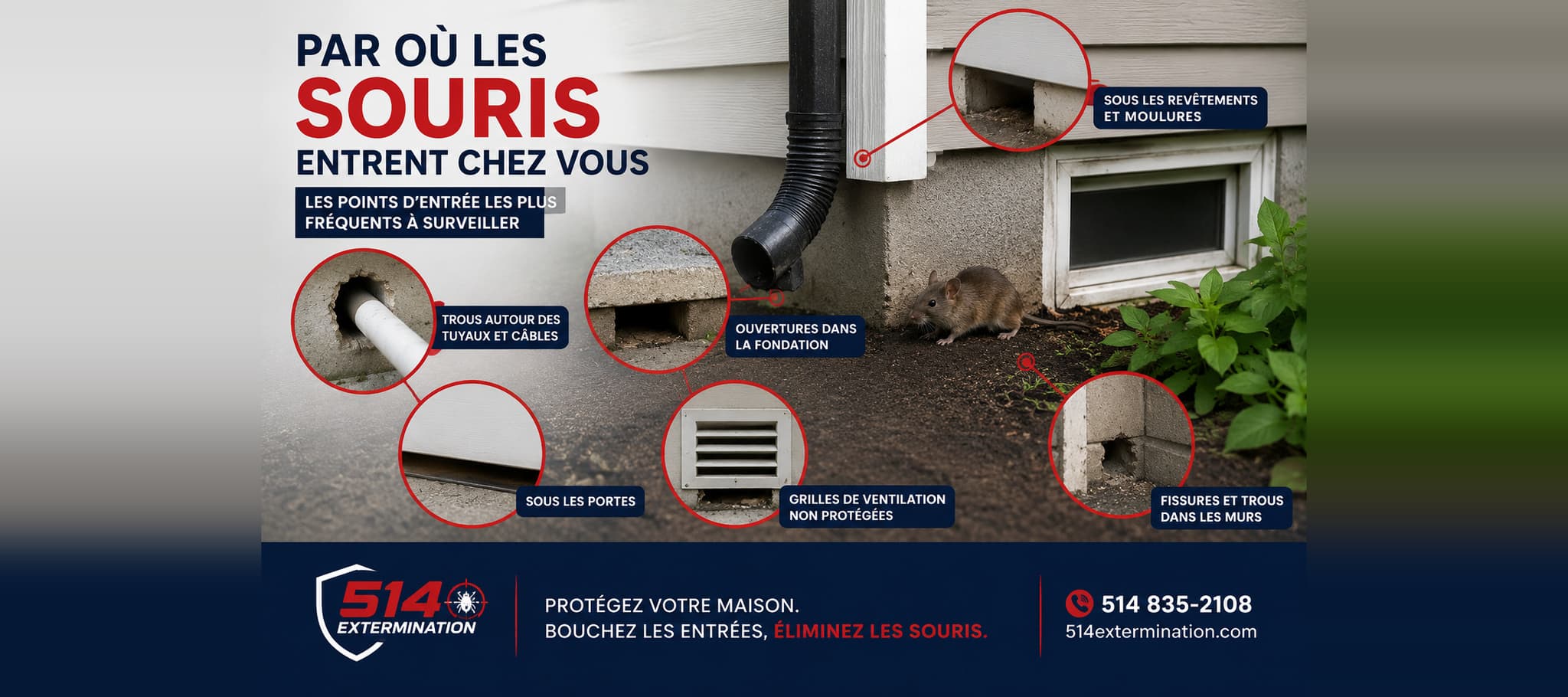
At that point the lasting fix is exclusion: closing every opening larger than 6 mm with materials mice cannot chew. The University of California is clear that expanding foam, rubber and vinyl do not hold. Our article on mouse entry points details where to look. And if you were thinking of poison, first read why it often makes things worse.
One rule to respect: nothing gets sealed while mice are still inside. Control and exclusion run together, and final sealing comes once activity has stopped.
Summary table
| Trap type | Effectiveness | Key point |
|---|---|---|
| Snap | High | First choice. Against the wall, at a right angle, bait toward the wall. |
| Electronic | High | More expensive, enclosed: less contact with children and pets. |
| Live capture | Moderate | Check very often. Releasing near the house is pointless. |
| Glue | Poor on adults | Advised against by the CDC: suffering, urine, accidental catches. |
| Ultrasonic | Little evidence | Mice get used to the sound, which does not pass obstacles. |
Sources
- Health Canada, Rats and mice (pest control tips).
- Centers for Disease Control and Prevention, How to Trap Up to Remove Rodents.
- University of California Statewide IPM Program, Pest Notes: House Mouse, publication 7483, revised July 2025.
For a free price estimate in Montreal, Laval, the South Shore or the North Shore, call us at (514) 835-2108. The on-site inspection is billed and deducted from the price of the treatment if you go ahead.
Frequently Asked Questions
What is the most effective mouse trap?
Why is my mouse trap not catching anything?
What bait should I put in a mouse trap?
Are glue traps a good idea?
Do ultrasonic repellers work against mice?
How long should traps be left out?
Need a professional exterminator?
Contact us for a free evaluation and a treatment plan tailored to your situation.